October 2026 · 20-minute read
From experimentation to P&L
How do large groups and scale-ups take AI to scale?
Interviews by Constellations with 25 Heads of AI in large groups (CAC 40 / mid-caps) and scale-ups (Next 40)
The real P&L impact of AI in 2026, the most effective organisational models, and concrete use cases by function
Written by





Louis Ravier, Aurélien Rayer, Enguerrand Hurstel, Elyes Zemni and Alexandre Breillot - Partners at Constellations
Key takeaways
Preamble. This white paper is written for executives and AI leaders who need to move from experimentation to impact. It has three aims: to take stock of the real P&L impact of AI in 2026, in large groups and scale-ups alike; to identify the most pragmatic organisational models and frameworks for scaling; and to document concrete, quantified use cases, by process and by function.
In 2026, the P&L impact of AI is real but concentrated. On processes that have genuinely been redesigned, our client cases show 30 to 80% of time saved and recovered revenue in the order of 1 to 3 points of EBIT. On processes that are merely “augmented”, it remains marginal. The lead these players have built rests on their organisational agility more than on their technology
The AI engine has become a commodity. In two years, the cost of GPT-3.5-level performance has fallen by a factor of roughly 280 (Stanford AI Index 2025). Models are interchangeable, and queries are routed from one to another. Technology alone is no longer, in itself, a differentiator.
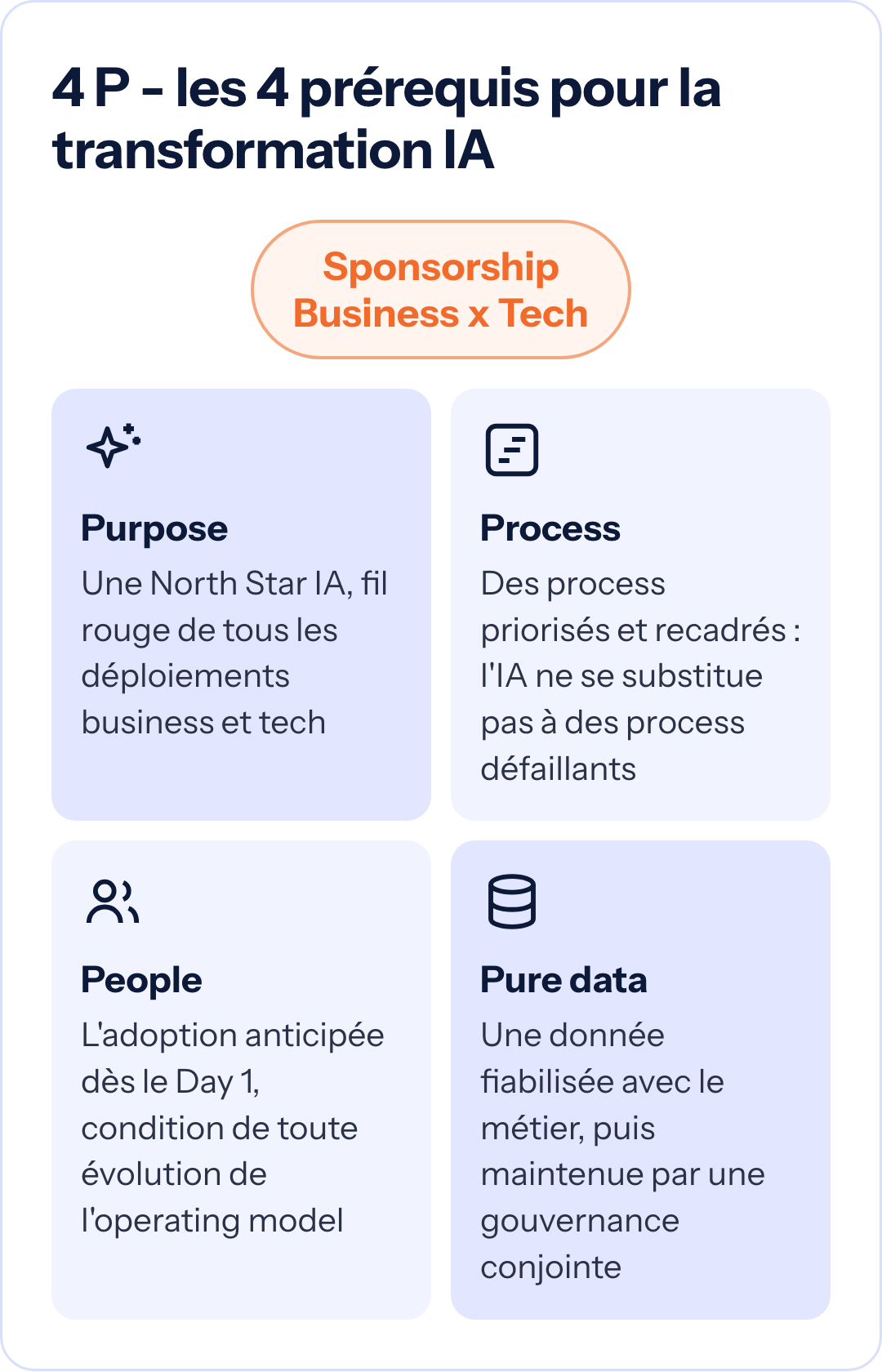
Competitive advantage will be built on four business prerequisites, none of which is technological.
the “North Star” underpinning the changes targeted for customers, for the company and for its people
don't layer AI on top of failing processes; prioritise and review processes with AI's impact built in, up to a complete redesign where AI is a lever for disruption
clean data, backed by a single source of truth and maintained by applied data governance
real, everyday adoption of the tools, the new processes and the target strategy, driven by clearly identified adoption owners
According to MIT (The GenAI Divide, 2025), 95% of generative AI pilots produce no measurable effect on the income statement. Our reading, drawn from our engagements and interviews: these failures have less to do with the technology than with one of these four prerequisites left unaddressed.
The next twelve months will deliver significant gains in the organisations that can transform fastest, and not necessarily in the companies furthest ahead on tech. We are already seeing striking results at scale-ups whose lead does not come from technology. They have neither better models nor better AI engineers. They can rework a process in a few weeks, they are clear about their strategy and value proposition, and they evolve their production model at the same pace.
Scaling is more demanding for large groups and mid-caps: entrenched processes, fragmented data, large numbers of people to bring along, non-negotiable compliance. The gap in pace is real. Catching up is of course possible, provided AI is treated as a strategic transformation, decided at ExCom level, with joint business and tech sponsorship.
That said, AI does not always call for a new analytical framework: process redesign methods still work. We have therefore revisited our framework in light of what AI makes possible - remove, accelerate, secure, simplify - and applied it function by function, limiting ourselves to what we have observed, verified and quantified in the field with our clients. These cases are gathered in the last part of the document.
Finally, in 2026, most leadership teams are choosing to reinvest the time saved in growth. The time freed up is reinvested in the offer and in customer value, in large groups and scale-ups alike. Cost reduction can always come later if it becomes necessary; what is at stake today is first to prove the value and to complete the AI transformation of one's model and group.
From a new technology to capturing value
The AI engine is becoming a commodity: models are converging, the cost of inference is falling fast, and companies are already arbitrating between providers. Differentiation will depend less on the engines than on how they are integrated into the core operating model: the clarity of the strategy and value proposition, the redesign of processes, the quality of data, the ability of teams to work differently. This is a business transformation, well beyond a choice of tool.
The companies that benefit from AI stand out less for their technology than for the way they integrate it into their means of production. That is what explains the lead of AI-native scale-ups: not better AI engineers, but recent processes, clean data and teams used to changing methods. And that is what makes AI, in a large group, an ExCom topic rather than an IT project, under joint business and tech sponsorship.
Our approach. This white paper draws on 25 interviews with Heads of AI and CDOs from the CAC 40, the Next 40 and French mid-caps, and on the AI transformation engagements led by our partners. It follows three questions: why 2026 marks the move to scale (Part I), how to structure the transformation (Part II), and which levers to activate, function by function (Part III).
Methodology
- Interviews: 25 semi-structured interviews, conducted between April and September 2026, with Heads of AI, CDOs and partners. Of these, 10 CAC 40 / SBF 120, 5 Next 40 / scale-ups and 10 mid-caps
- Client cases: drawn from our partners' engagements, anonymised; figures validated with the clients concerned
- Public sources: company communications and press, cited in the document
- Scope: a qualitative reading, not statistically representative. Impacts are self-reported where they have not been measured
Why now? 2026, P&L impact at scale
P&L impact is changing scale in the most agile companies. Large groups are hitting the wall of scaling.
- 01 2026 - P&L impact is materialising, but unevenly
- 02 The cost of AI: a line to manage “by design”
- 03 ROI: reallocating resources to growth
2026 - P&L impact is materialising, but unevenly
Three time arcs in twenty-four months
- 2024 - individual use. GPT or Claude adopted spontaneously, by individuals. Real personal gains, but little value captured by the organisation
- 2025 - exploration. POCs multiply, the first agents appear, and budgets rise considerably. But use cases remain confined, little adopted, rarely industrialised
- 2026 - scale and profitability. The impact on the income statement is already visible at AI-native companies. A double pressure sets in: AI costs that have become an identified line item, and a board expecting quantified topline impact
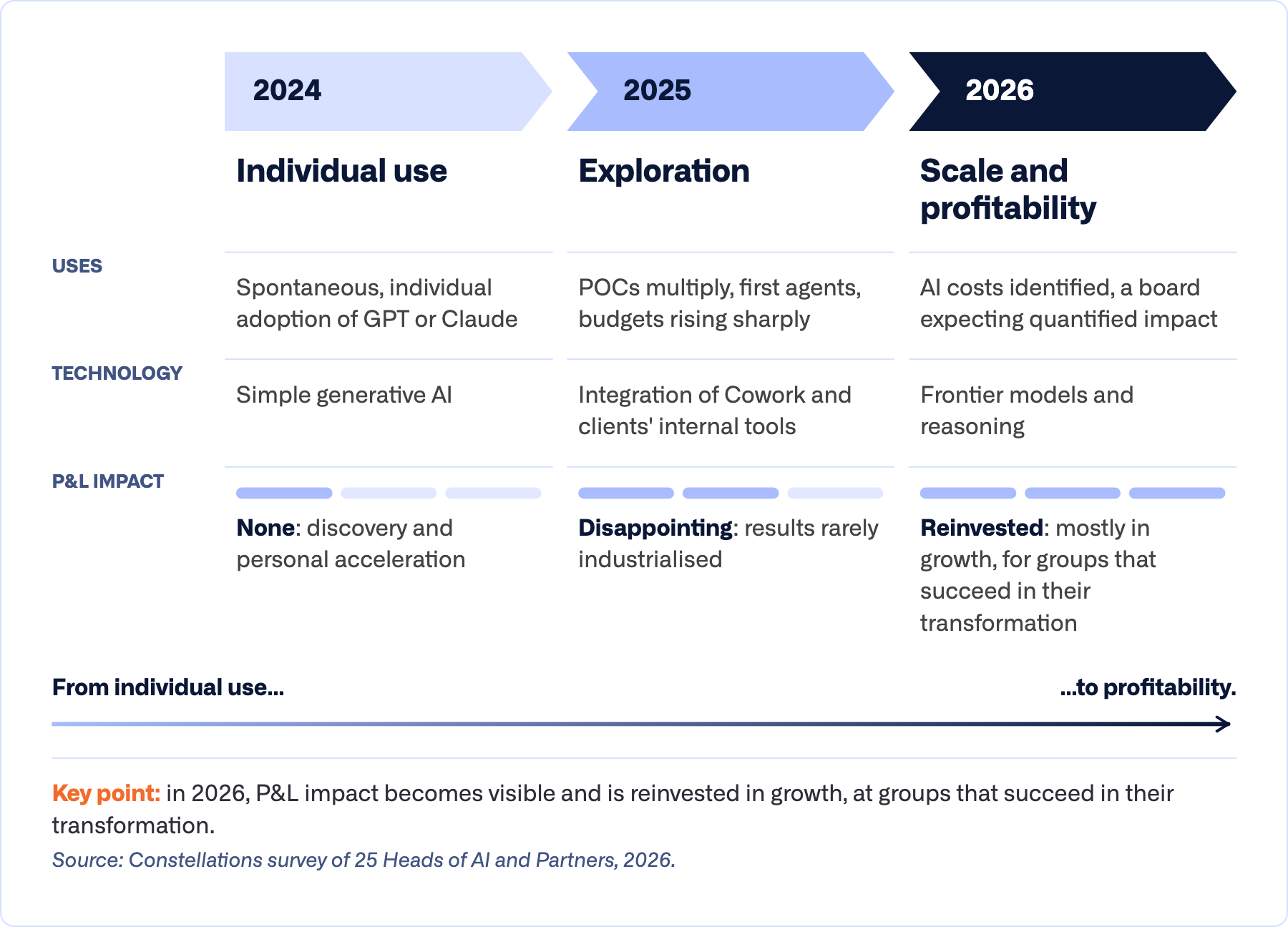
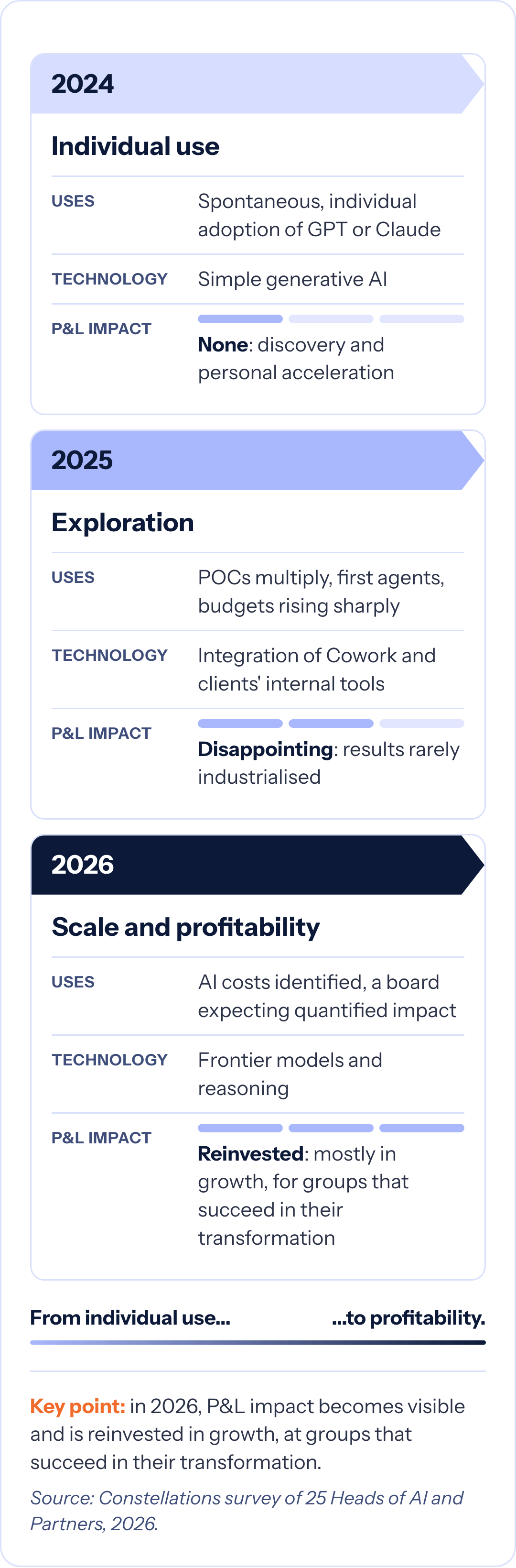
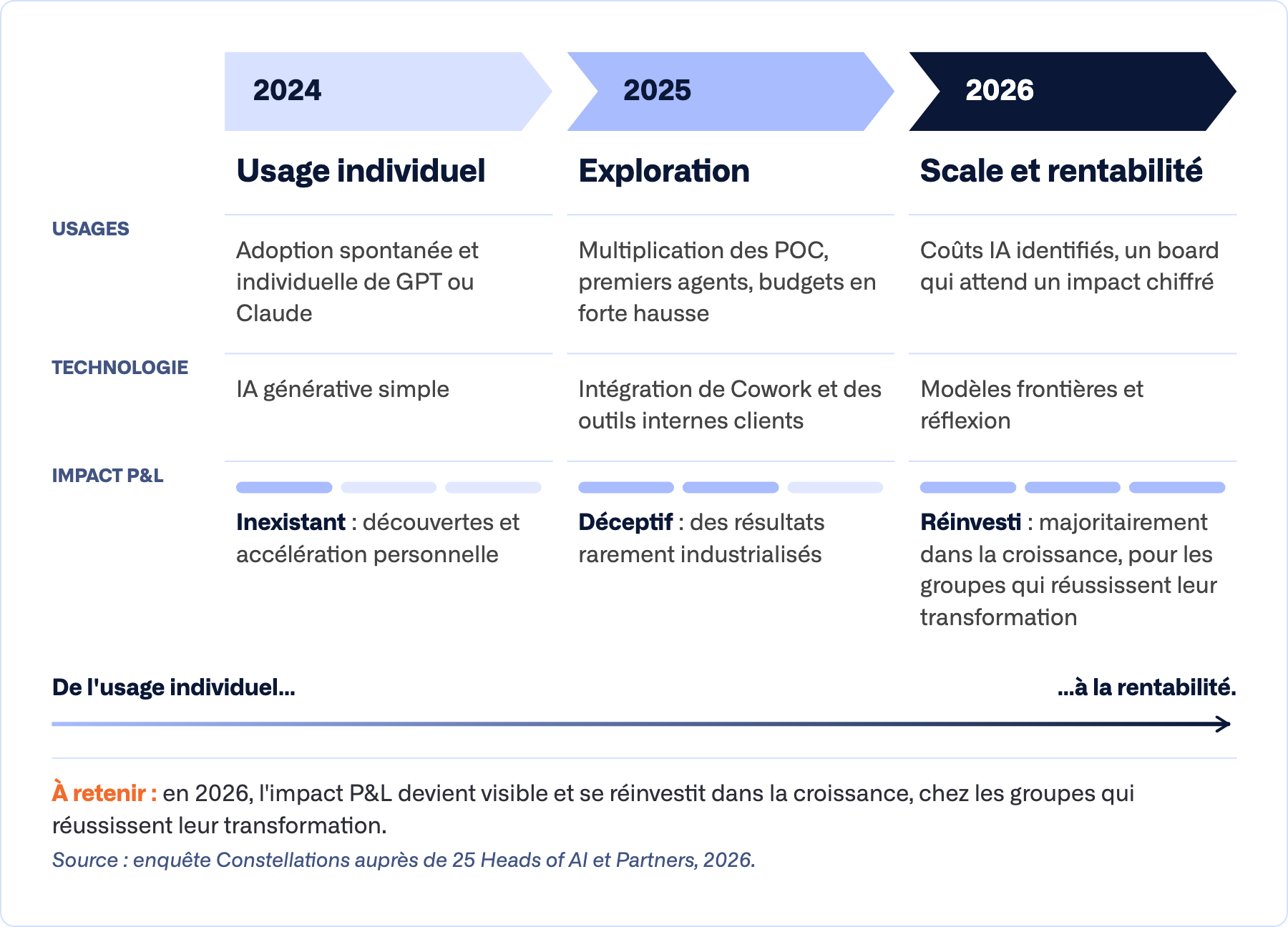
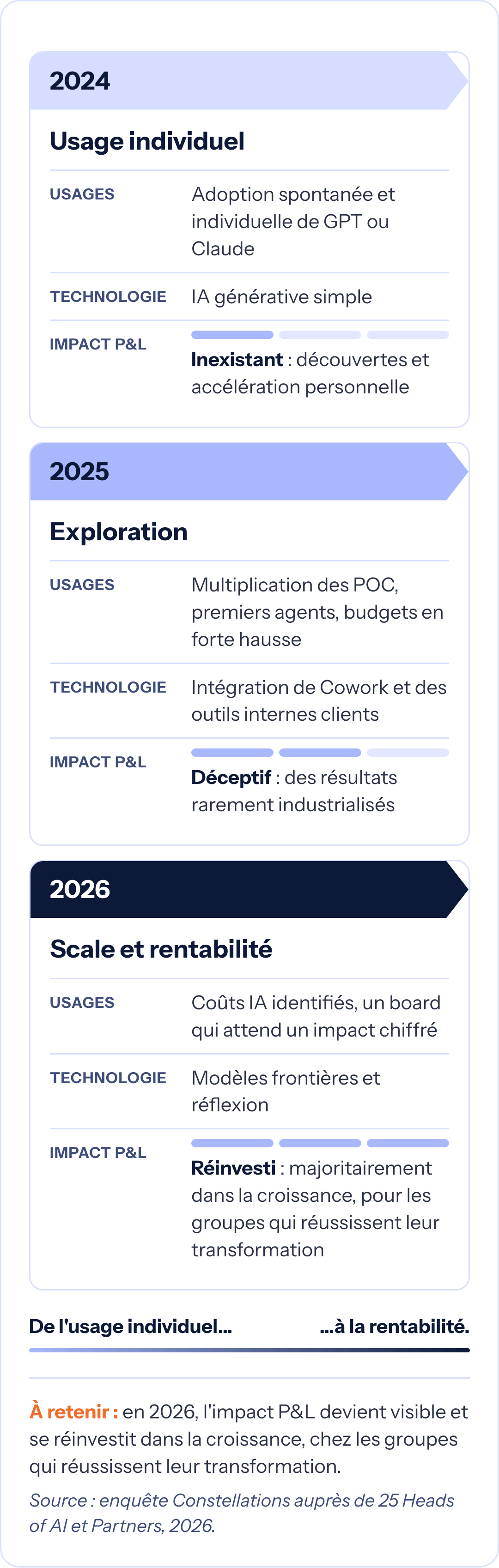
From individual use to profitability: three arcs in twenty-four months
Spectacular gains, concentrated in AI-native organisations
Where the organisation is agile, versatile and built around data, the gains are considerable and time-to-market collapses.
Alan, a French Next 40 scale-up, gives a public measure of this: 40% of its members' requests are resolved instantly by its AI assistants - up to 70% for simple requests - with satisfaction stable at 4.5 out of 5. Over the same period, membership grew by 34% with a constant customer support team, and overall productivity by around 30% in one year.
At another fintech scale-up, setting up a creative factory, backed by a library of creative assets, lets local teams adapt assets by prompt. The share of AI-generated assets went from 5% to more than 80% in two quarters, against an initial target of 25%; the tool was built in a 15-day sprint.
For us, AI is a company objective, not a side project: 75% of the Growth team uses it every day, and we went from 5 to 80% of visuals produced by AI in two quarters.
AI Growth Lead, Scale-Up - Fintech
The real challenge: scaling in large groups
In a large group, complexity is structurally higher - deeply entrenched processes and a reduced capacity to adapt, data that is far more complex and fragmented, more teams to train, and non-negotiable compliance and cybersecurity requirements.
The ExCom wants results right now, not ‘wait eight months while we clean the data’.
Performance Director, Mid-cap - Industry
We launched an email analysis POC for customer support, then stopped it: the data wasn't ready yet. We preferred to make it reliable first rather than run an AI on incomplete databases.
AI Lead, European infrastructure operator - Telecom
2026 provided several public illustrations of this, including at leading players.
The setbacks of 2026 - When scaling stalls
after launching its use-case factory
All AI funding frozen, while it refocused its North Star, narrowed the scope to 2 priority business lines and improved its data quality first

after deployment, the system was withdrawn
The computer-vision inventory system was withdrawn from the entire North American estate, for lack of reliability

agents whose work AI absorbed in 2024
From 2025, humans were rehired to restore service quality, with a shift to a hybrid model
Sources: Constellations experience (Industry, CAC 40); Reuters and CNBC (Starbucks); Bloomberg, Reuters (Klarna)
Real wins show the way at large groups that move forward by treating AI as an evolution of their production model.
The wins - When AI transforms the production model

of value released
AI supplier management platform (more than 100,000 suppliers, 190 countries): purchasing costs down 4%, supply disruptions down 17%

product development speed
By focusing AI on predicting molecular efficacy

engineering productivity
Coding agents (Devin + Claude) across around 12,000 developers, mainly on legacy IT modernisation
Sources: business and trade press; company communications
The cost of AI: a line to manage “by design”
The cost of AI has become a CEO-level topic in less than a year.
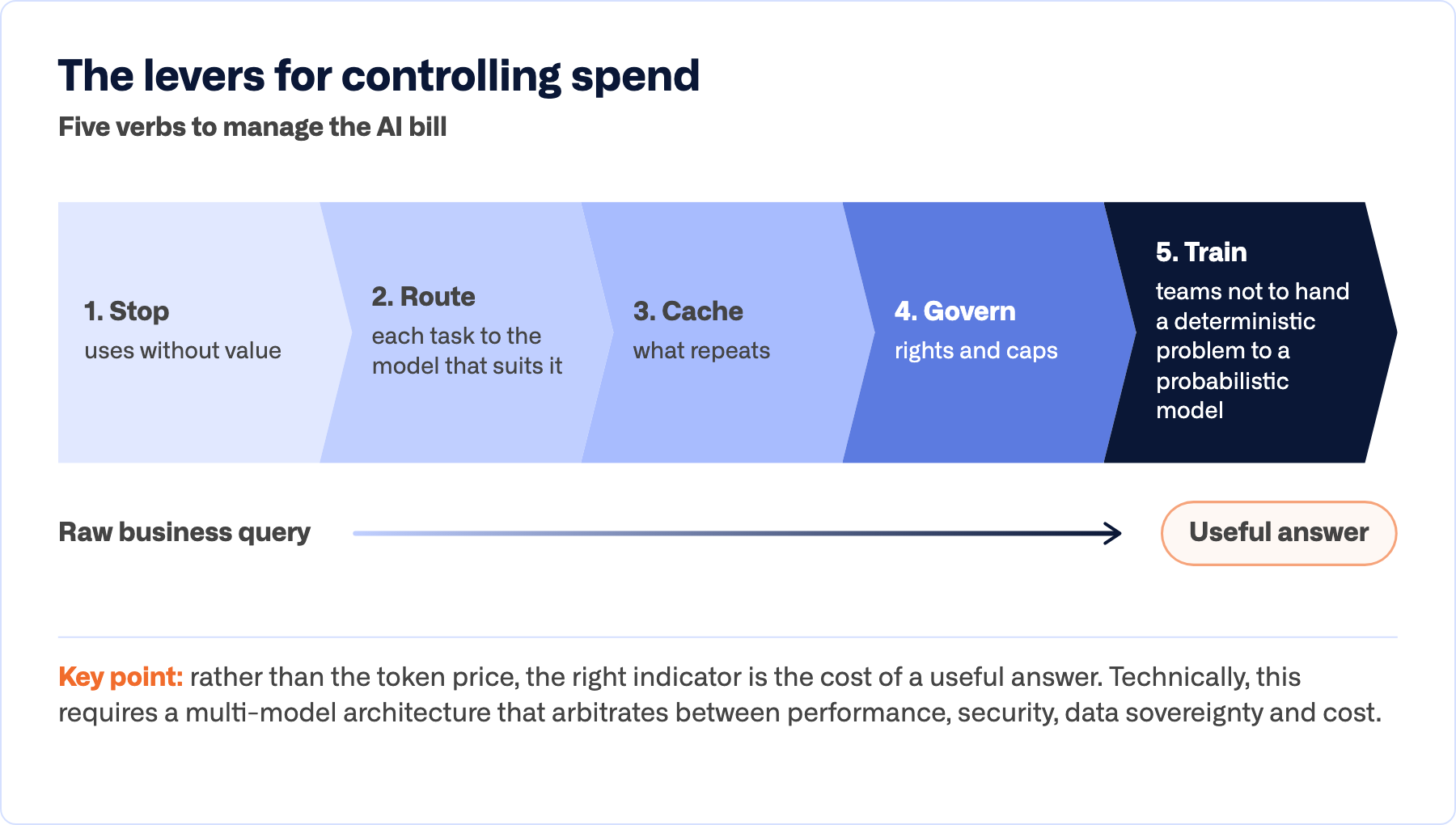
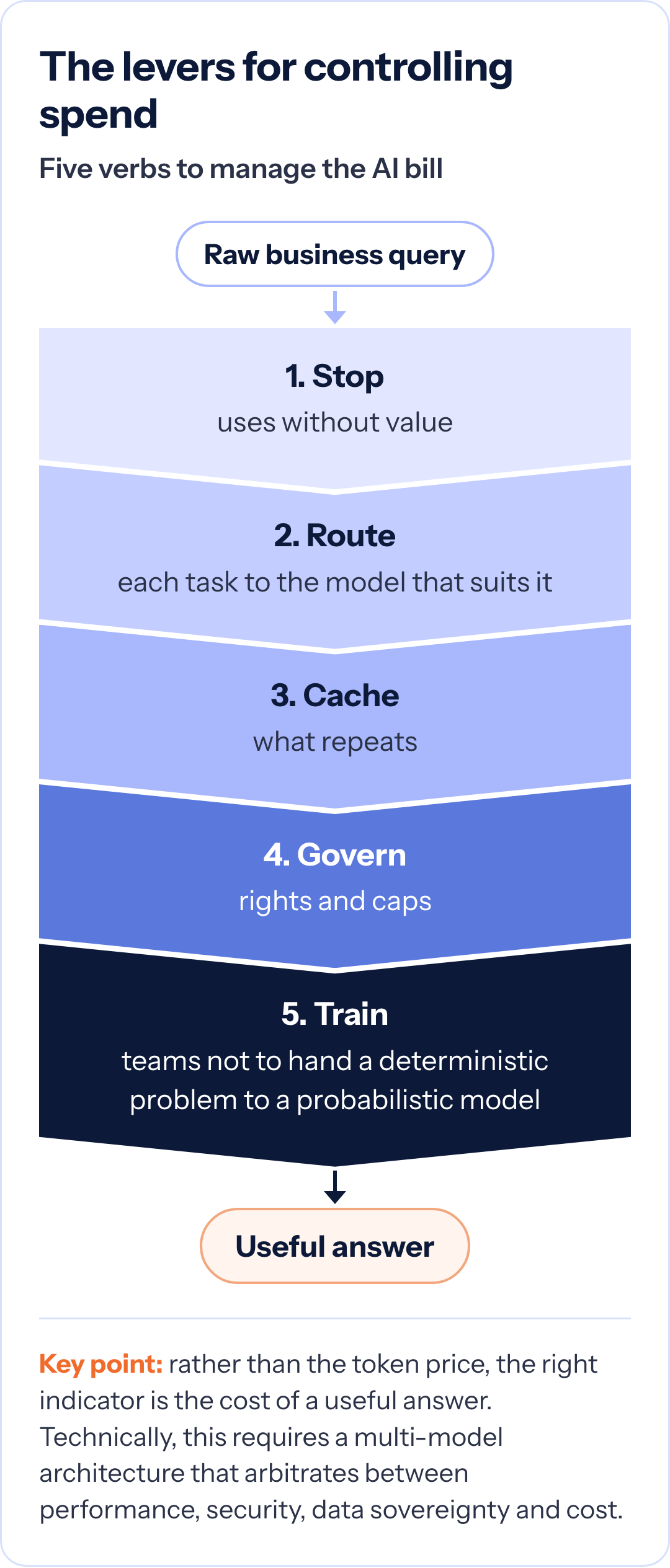
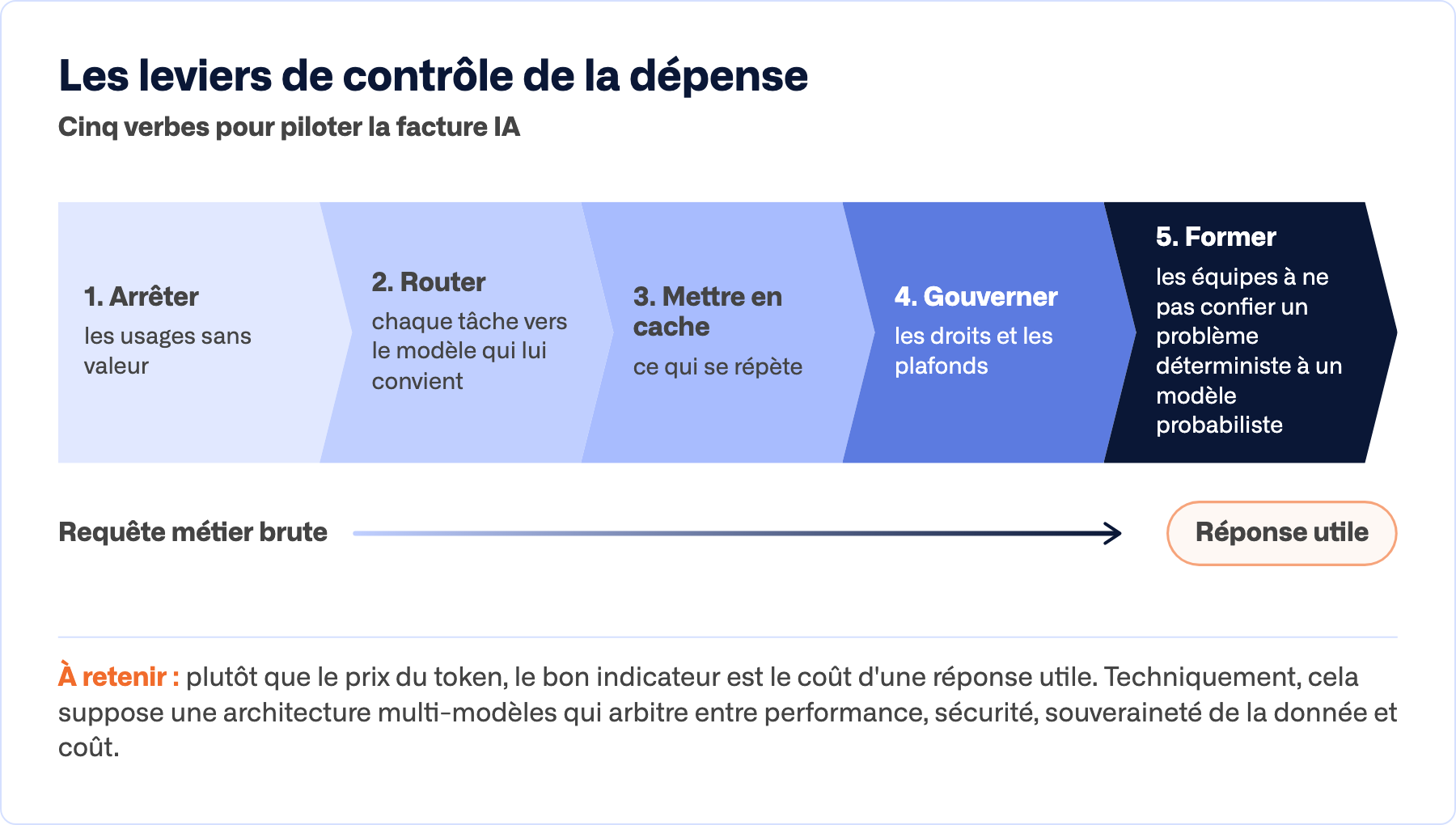
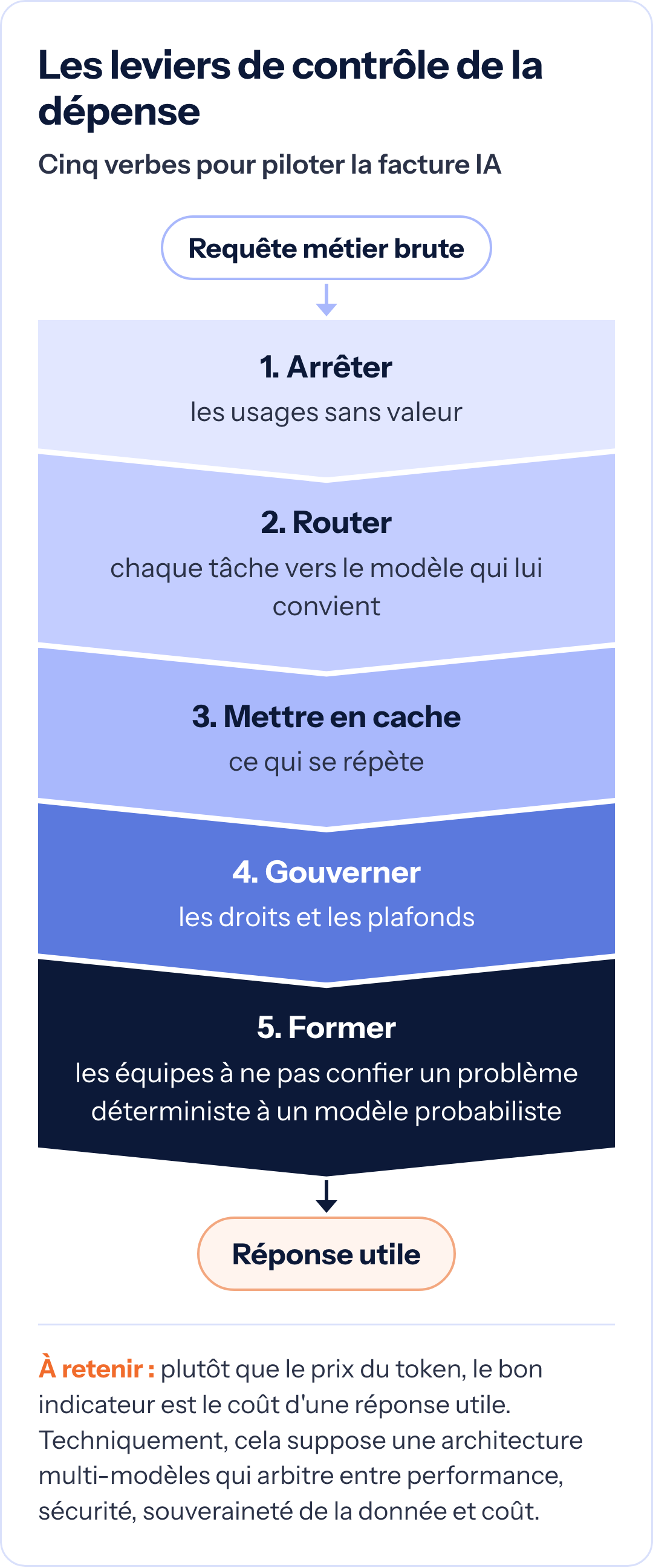
The AI bill has become variable and hard to manage: we have moved from per-user subscriptions to pay-per-use consumption, and agents can consume a lot. The spend hits the income statement on several lines at once (investment, operating expenses, cost of sales) and becomes hard to allocate.
The unit price falls, the bill rises: the cost per query is collapsing, but consumption is growing faster. Reasoning twice as long can cost four times as much, and a chain of agents left to run autonomously can amplify its errors (up to 17.2x without a coordinator, Google DeepMind 2025).
Rather than the token price, the right indicator is the cost of a useful answer (cost-of-pass): the cost of a query that leads to a relevant solution, compared with the same task done by an expert. On an accounting close, the typical order of magnitude is around ten dollars against a week of an accountant's time.
Our objective was to set up a frugal, agnostic, multi-platform AI Operating Model, with data sovereignty.
AI Lead, Large Cap - Telecom
In an integration, you set a synergy budget and track it line by line. The AI bill deserves the same discipline: an owner for each use case, a unit cost tracked every month, and a clear decision between what scales and what you stop.
Elyes Zemni · Partner | Transactions & Integration, Constellations
At a Next 40 health scale-up, every leader now has a dedicated budget line for tokens, and designs their team by trading off hiring against agent consumption. Since late 2025, every manager also has to describe their ‘AI native’ roadmap: which agents for which processes, what token budget, and where people remain central.
AI Adoption Consultant, Next 40 - Health
The cost-of-pass of an iteration
On a client master data set, too large to clean manually line by line, we asked an agent to design a cleaning algorithm. After functional scoping with the business, half a day of runs produced an algorithm covering most of the scope. As the marginal cost of a run is close to zero, several hypotheses were tested and iterated on the real data in the same session
a data lead alone, with no dedicated developer, many variants tested on the full database
of a senior Python data scientist full time for a first draft to challenge, with few iterations possible
AI impact: an accelerated J-curve - costs that rise faster than productivity at first
This is the lesson of electrification. At the turn of the 20th century, it took nearly forty years and a complete reorganisation of factories to draw productivity gains from it. AI is replaying the same pattern, much faster: gains materialise after a phase of process redesign, upskilling and reorganisation that is hard to put a value on.
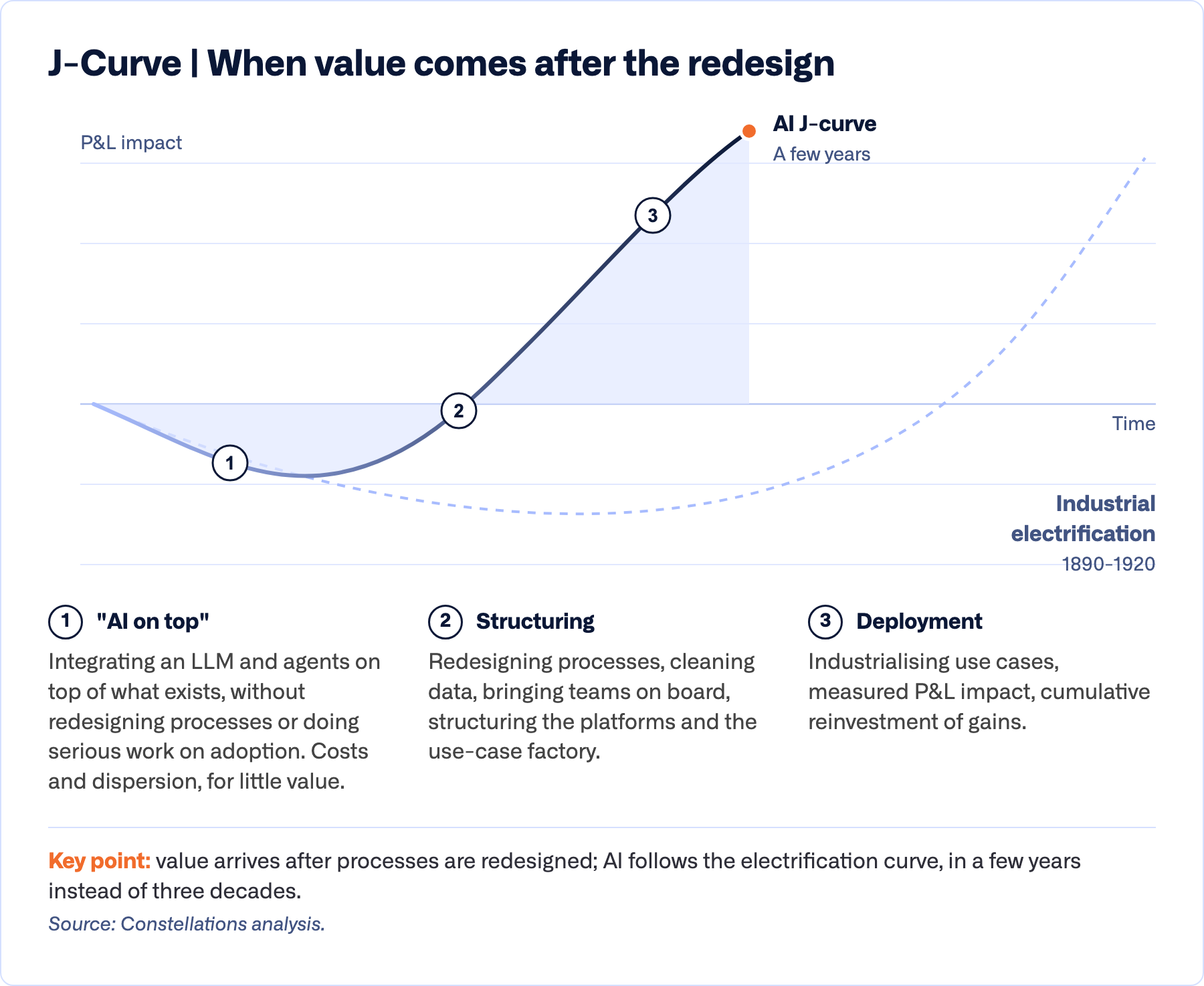
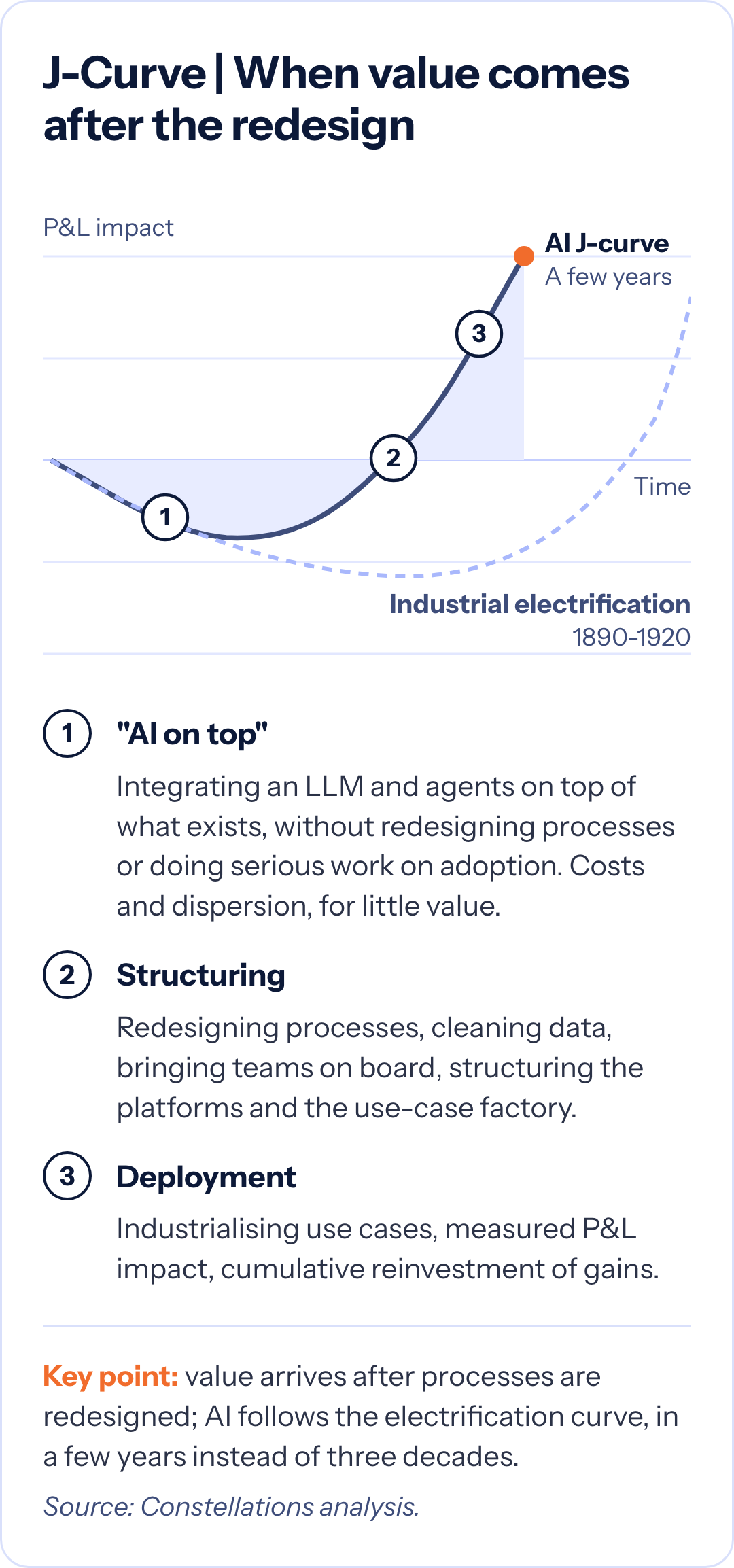
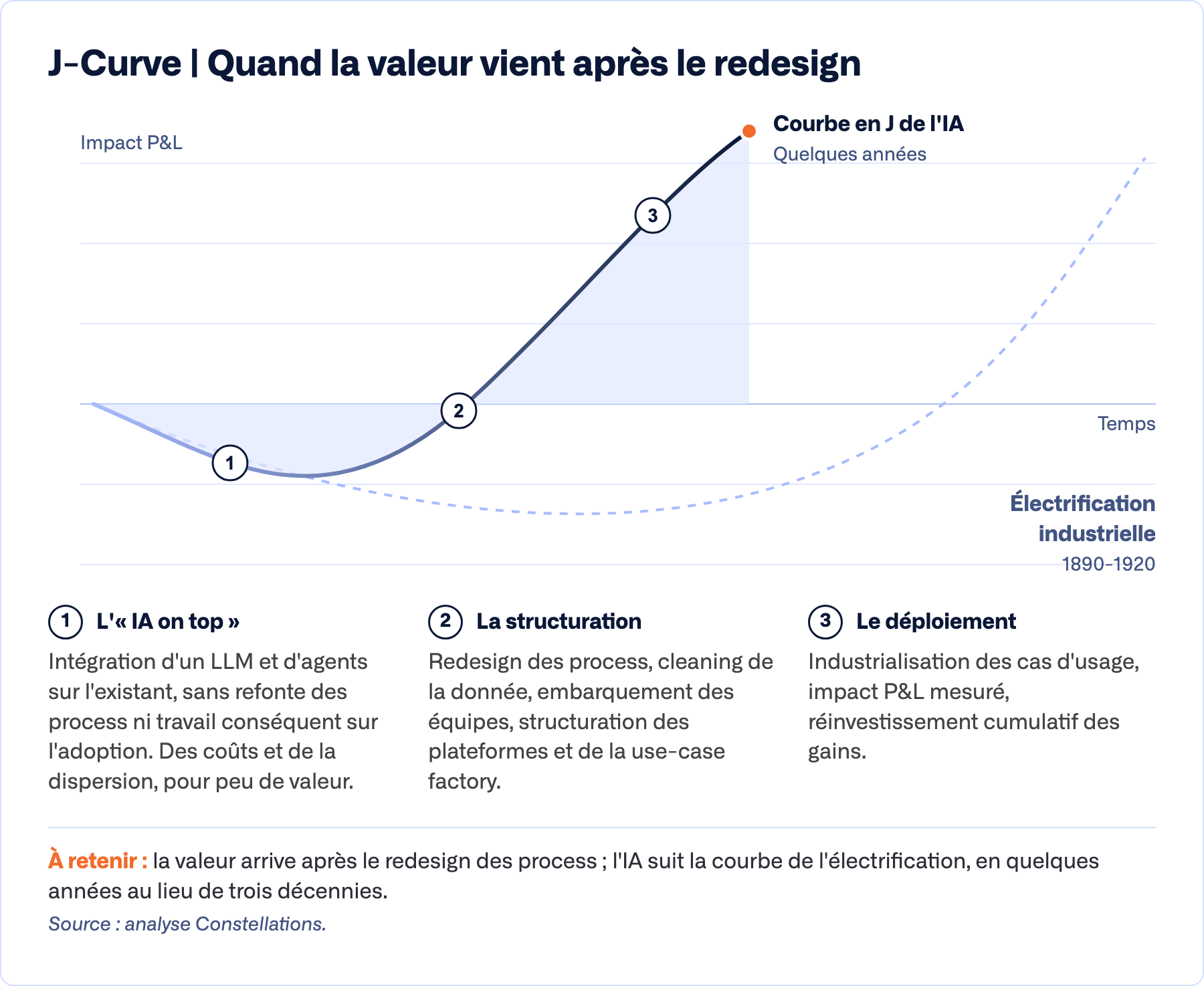

This moment when the gains are slow to come is actually the most decisive: it is where you separate the use cases that matter from those that will never make a difference. The right response is less about reducing ambition than about sharpening the direction, reprioritising, and consolidating the foundations - data, processes, integration - on which everything else will rest. Organisations that pull back here mistake an investment phase for a failure. Those that hold on, with discipline, are the ones that capture the value later.
Louis Ravier · Partner | Strategy & Performance, Constellations
ROI: reallocating resources to growth
At this stage, the return on investment of AI shows up more in reinvested productivity than in costs saved. Our engagements and recent studies converge: gains are, for now, reinvested in growth - new offers, customer value, broader team scopes - rather than captured as headcount reduction.
The first gain is time freed up, to be reallocated. If it is not managed, it is lost.
IKEA - Ingka Group: from call centre to revenue channel
of customer service requests absorbed by the Billie chatbot
advisers retrained as remote interior design consultants
of revenue for the remote sales channel, ≈3.3% of sales
of group sales: the target for 2028
Ingka Group's Billie chatbot (Ingka is IKEA's main entity) handles around 47% of customer service requests - 3.2 million conversations, close to €13 million in operational savings. Rather than cutting headcount, the group retrained its 8,500 call-centre advisers as remote interior design consultants: analysing the requests the bot could not resolve had revealed a latent demand for advice, invisible while teams were absorbed by transactional work. The remote sales channel created in this way generates €1.3bn in revenue, around 3.3% of group sales, with a target of 10% in 2028
Sources: Ingka Group, Reuters, Harvard Business Review. Public figures - see methodology note
Measuring impact: the hardest exercise
Time saved is hard to trace. During adoption, you first build the reflex, then refine the measurement. Practices vary widely among the people we spoke to.
At a Next 40 fintech scale-up, one person works full time on estimating AI's impact, to decide what should be industrialised, rescoped or stopped.
Conversely, a private equity player has given up on bottom-up tracking:
At this stage, we have stopped tracking impact bottom-up. We settle for a top-down pre-analysis before launching the use case.
AI Lead, Large Cap - Private Equity
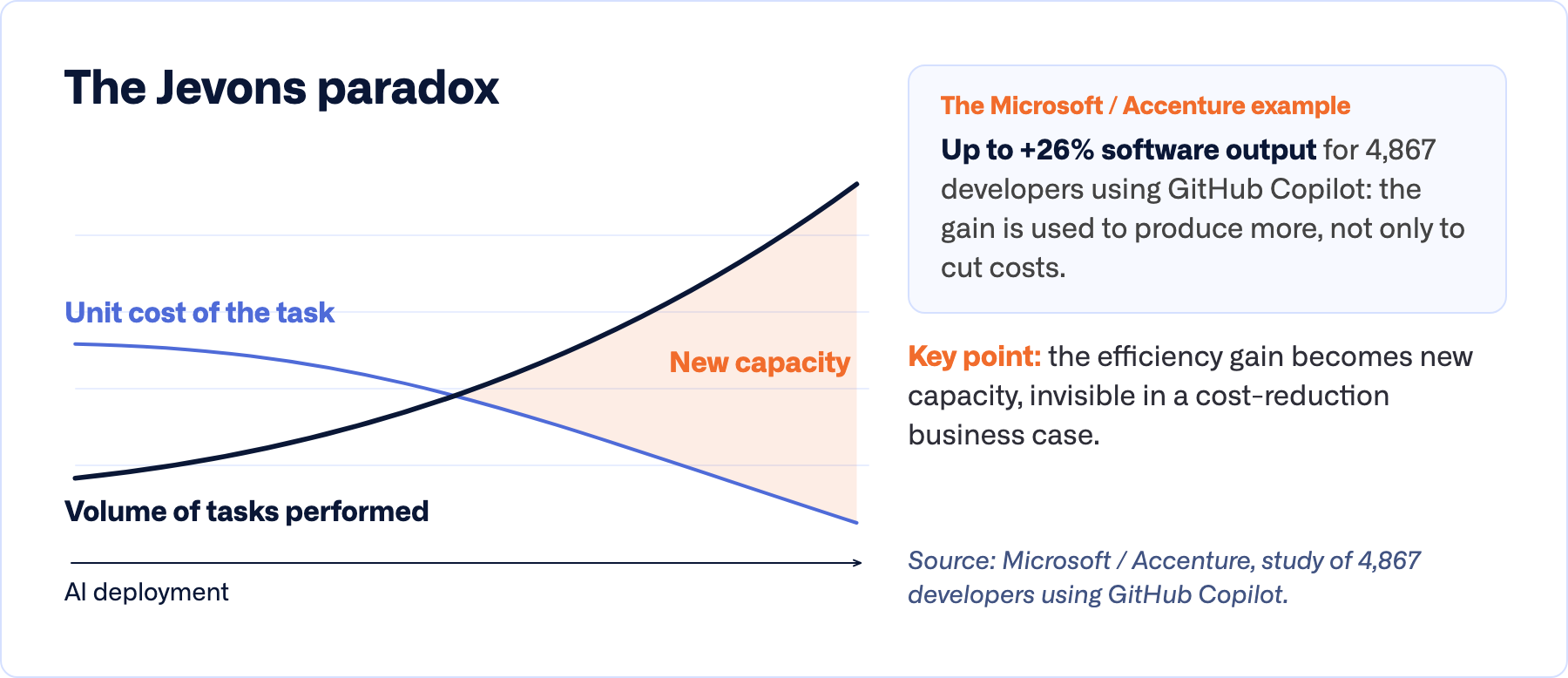
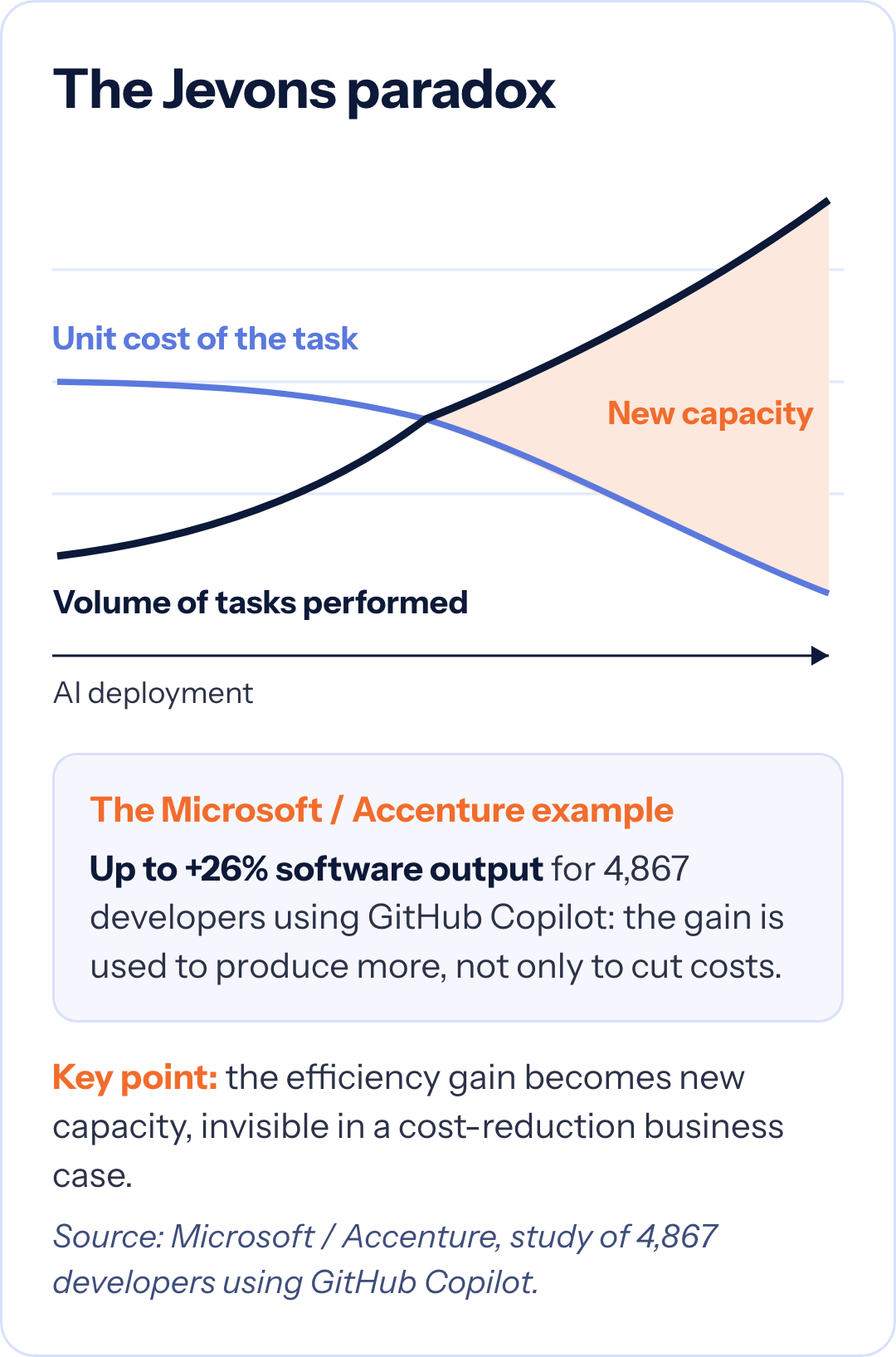
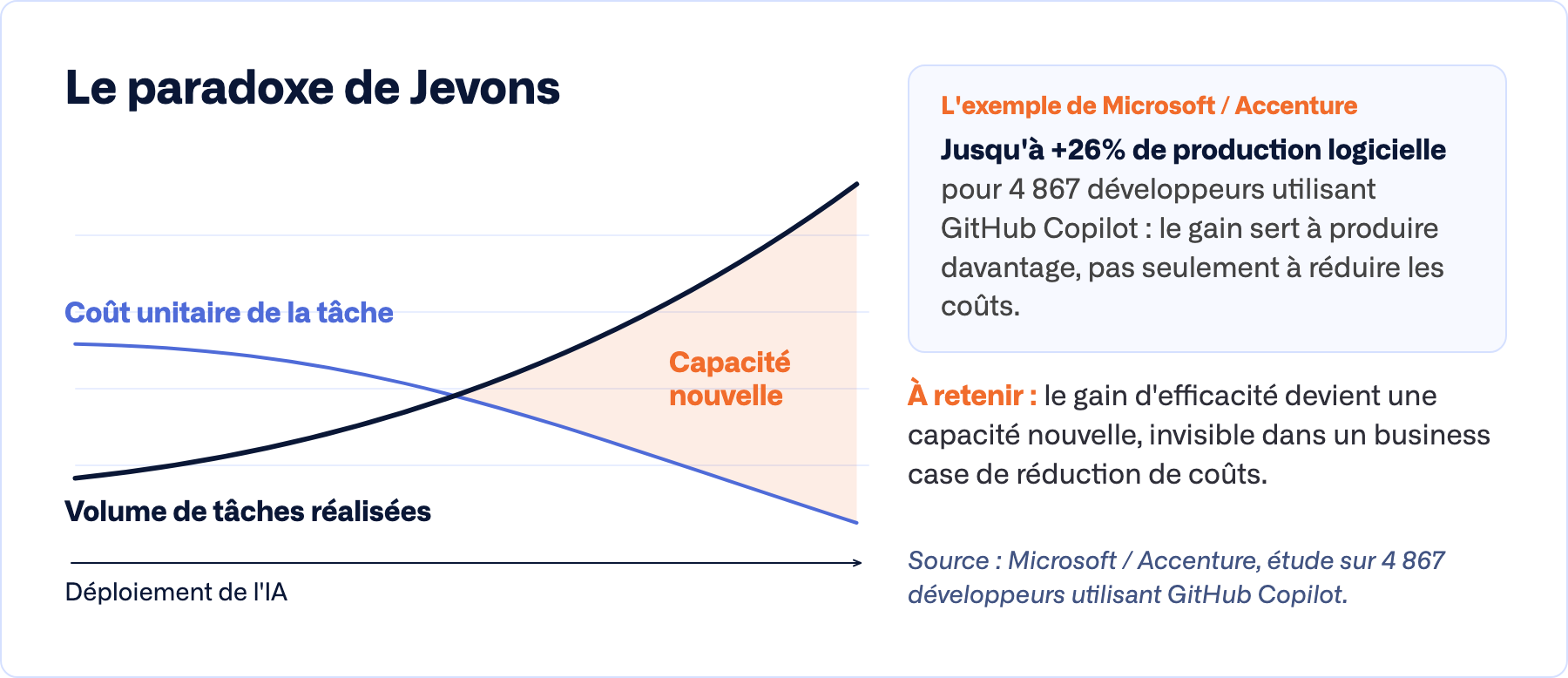
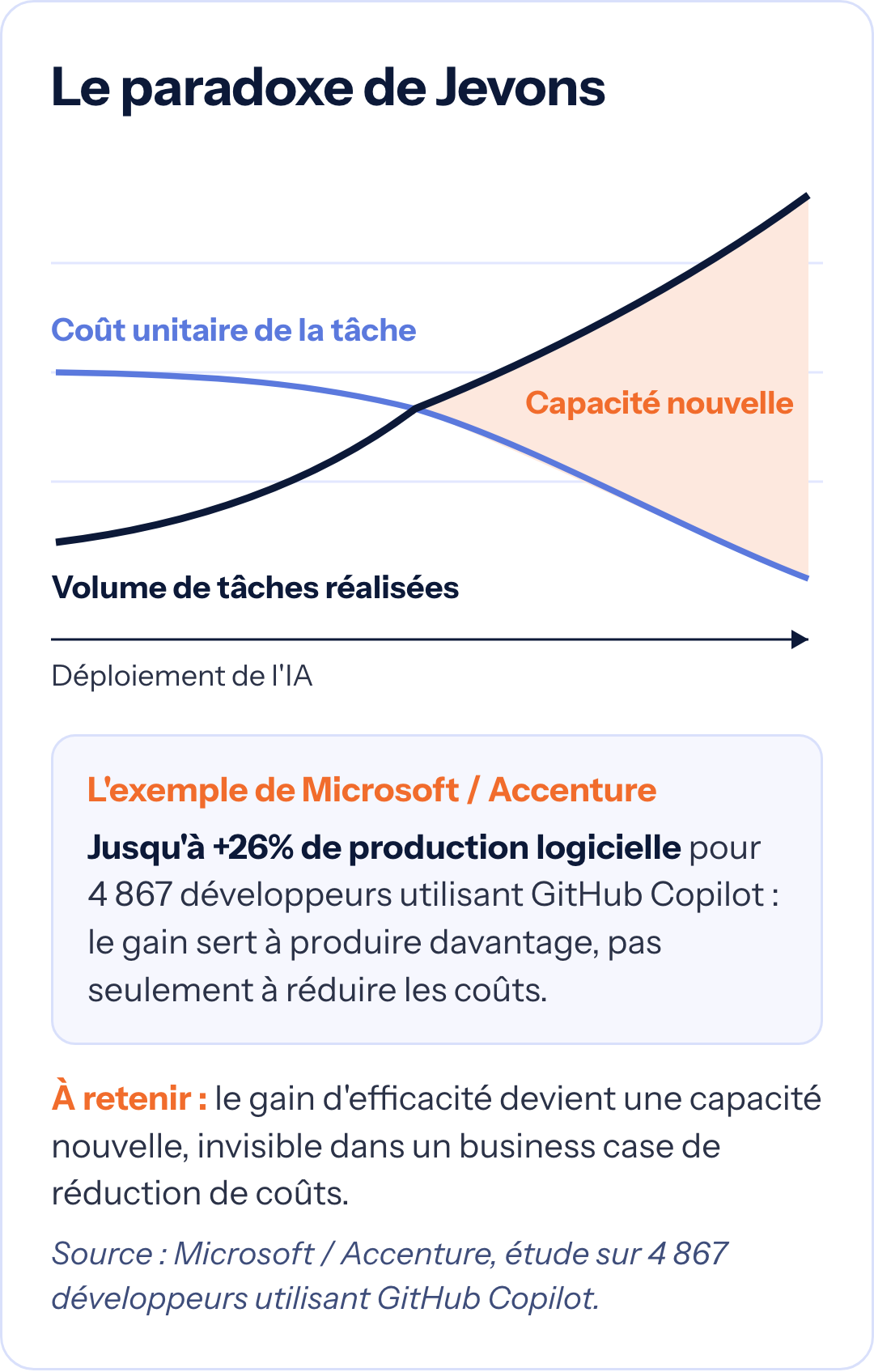
AI changes nothing about the rule of any transformation: measurement must not delay the launch, it must frame it. A quantified objective set by the sponsor before starting, an ROI used first to prioritise and then to correct, a real impact tracked over time. Without that, you don't know whether you are fighting the right battle - and you get neither the teams' buy-in nor the budget for the next wave.
Louis Ravier · Partner | Strategy & Performance, Constellations
A race won first on growth
The first player in a sector to turn AI into a net gain on its value proposition and business model will take the upper hand for several years. Hence the priority given to growth, to broadening the offer and to customer value, rather than to headcount reduction - there will always be time to activate the operational gains
How? Driving the AI transformation, from POC to Use-Case Factory
Moving from POC to scale is at least as much a question of organisation as of technology. Here is what our work with large groups and French mid-caps has taught us about how to structure an AI Use-Case Factory, and how to get it adopted.
- 01 The dual Business x Tech requirement
- 02 The 4 Ps: the prerequisites before deploying the factory
- 03 Use-Case Factory - a group-wide transformation programme
The dual Business x Tech requirement
Joint ExCom sponsorship - Business x Tech
AI is not a Tech or IT programme: it involves strategy, the business model, governance, operations, then teams and their adoption. Cross-functional sponsorship is therefore essential: it guarantees the prioritisation of use cases, settles functional trade-offs and drives adoption once delivery is complete. Technology, for its part, holds the platform: the data and agent foundation, integration with the IT system, quality, security. Neither can carry the transformation alone: trade-offs go up to the executive committee.
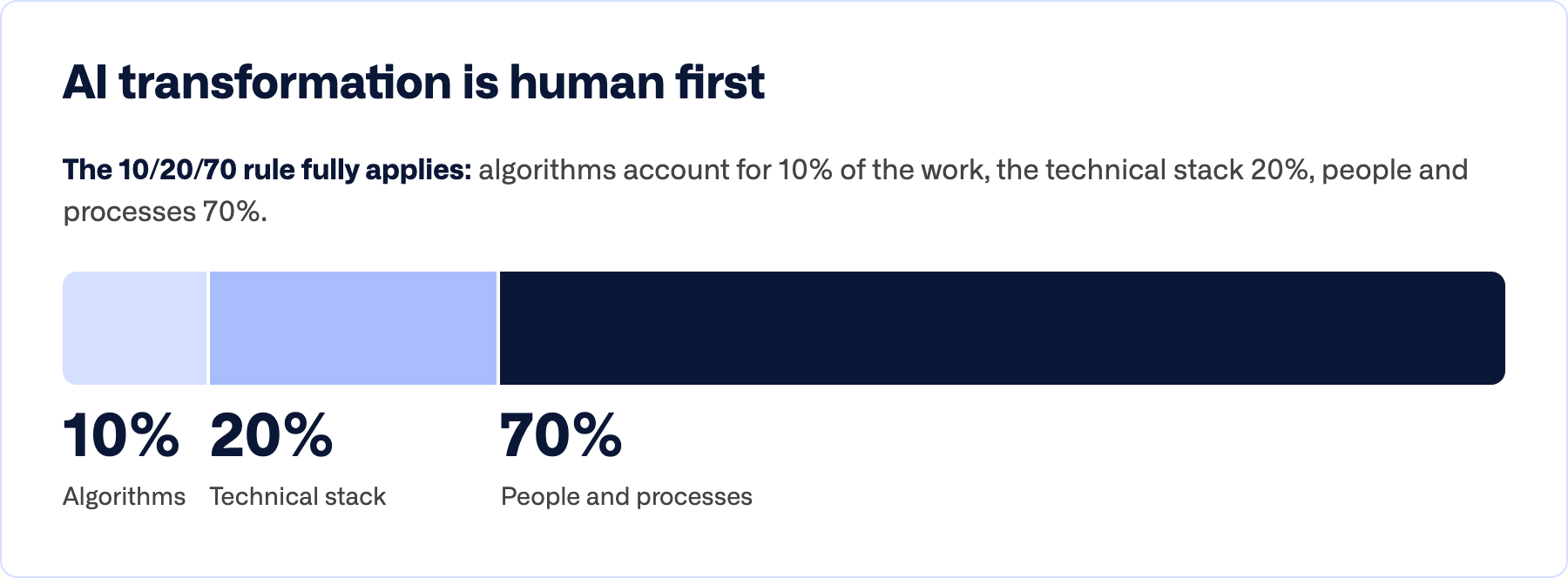


Deploying AI at scale is an ExCom topic: trade-offs are made at the highest level, and you need people able to work with C-level executives. Aligning business and tech sponsors determines whether the programme exists at all. That is why 100% of our AI engagements are under shared sponsorship, and 100% of our teams combine strategy consultants with tech profiles from the best agencies.
Louis Ravier · Partner | Strategy & Performance, Constellations
The 4 Ps: the prerequisites before deploying the factory
Our experience and our interviews converge on four business prerequisites, none of which is purely technological.
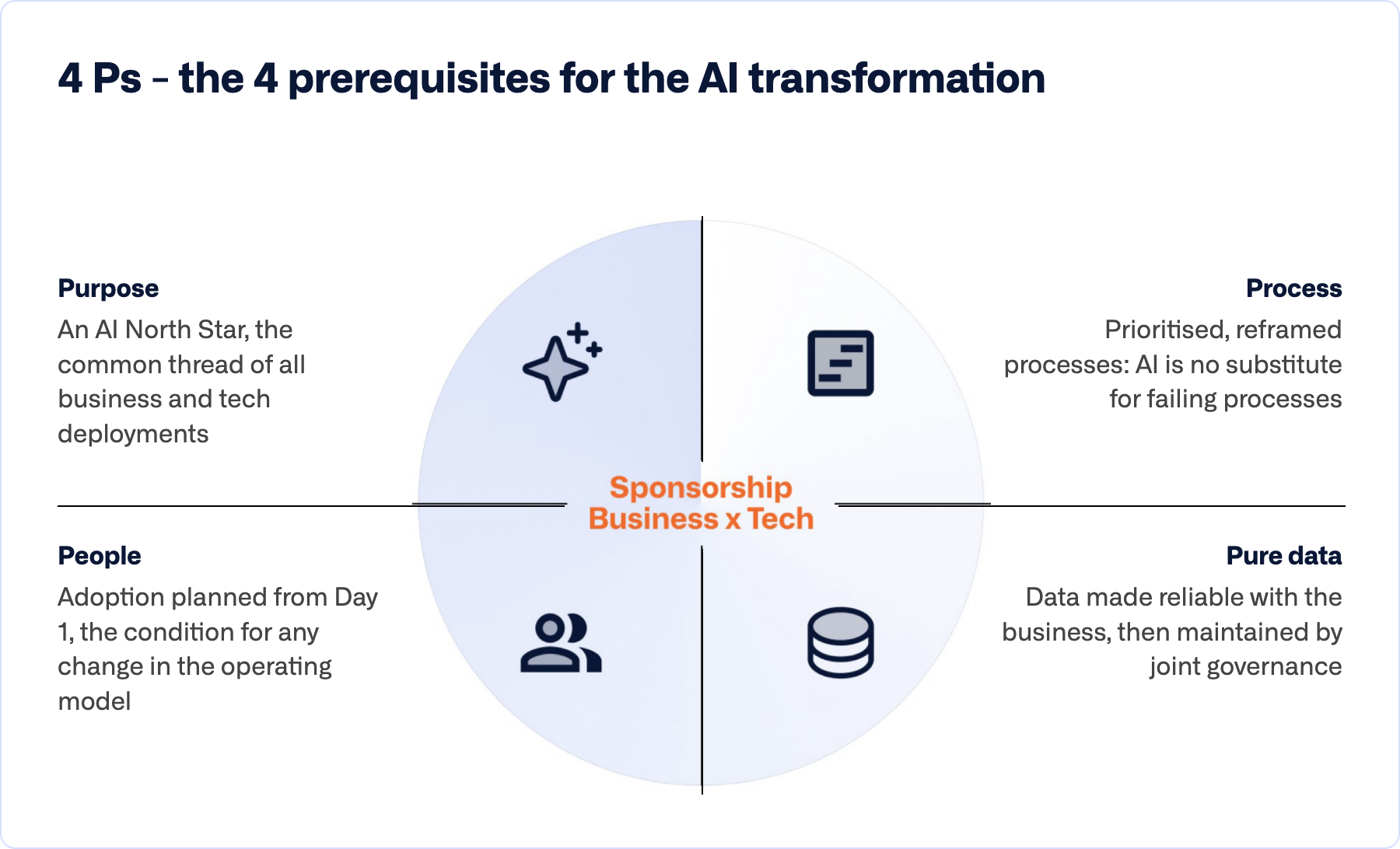
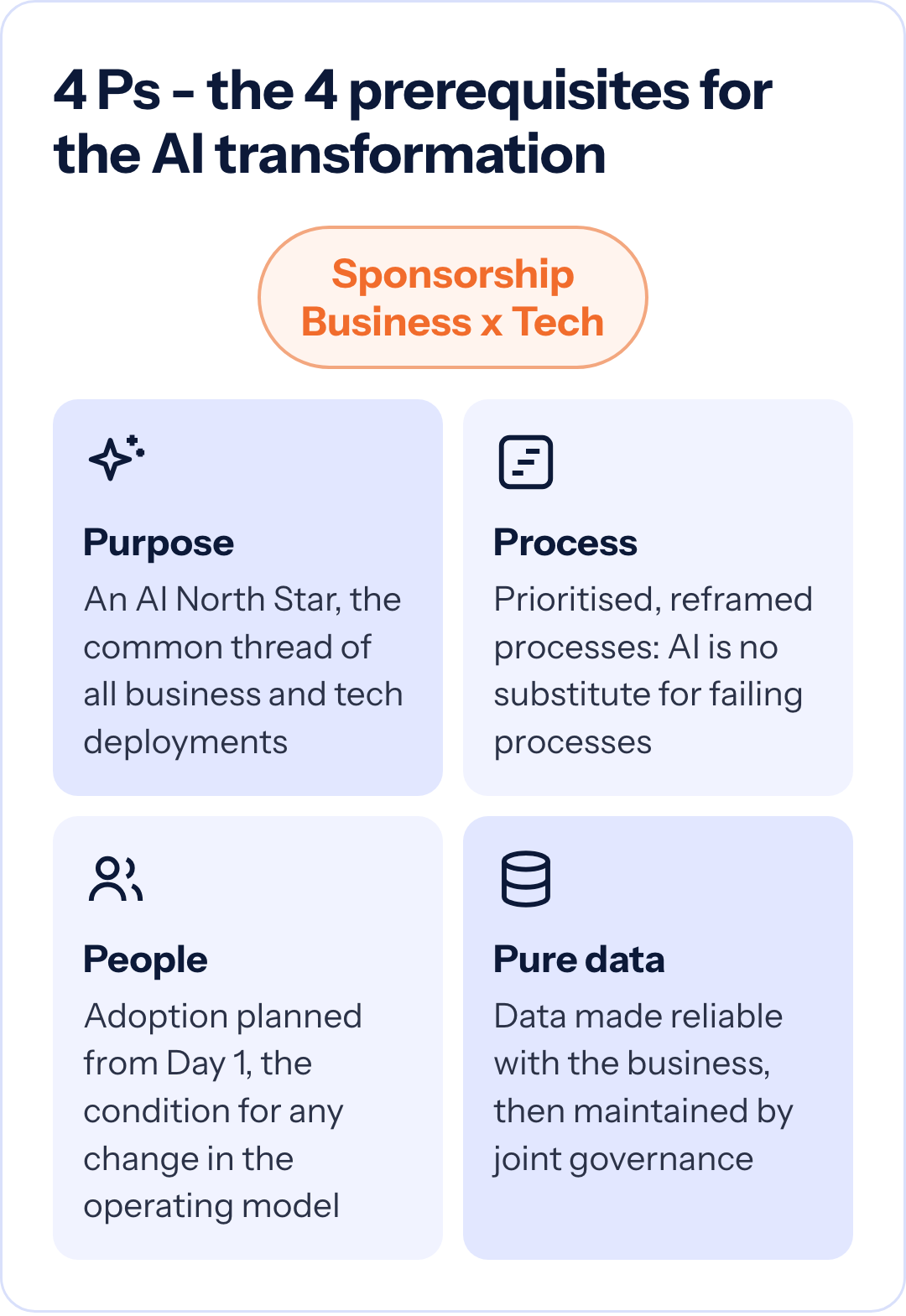
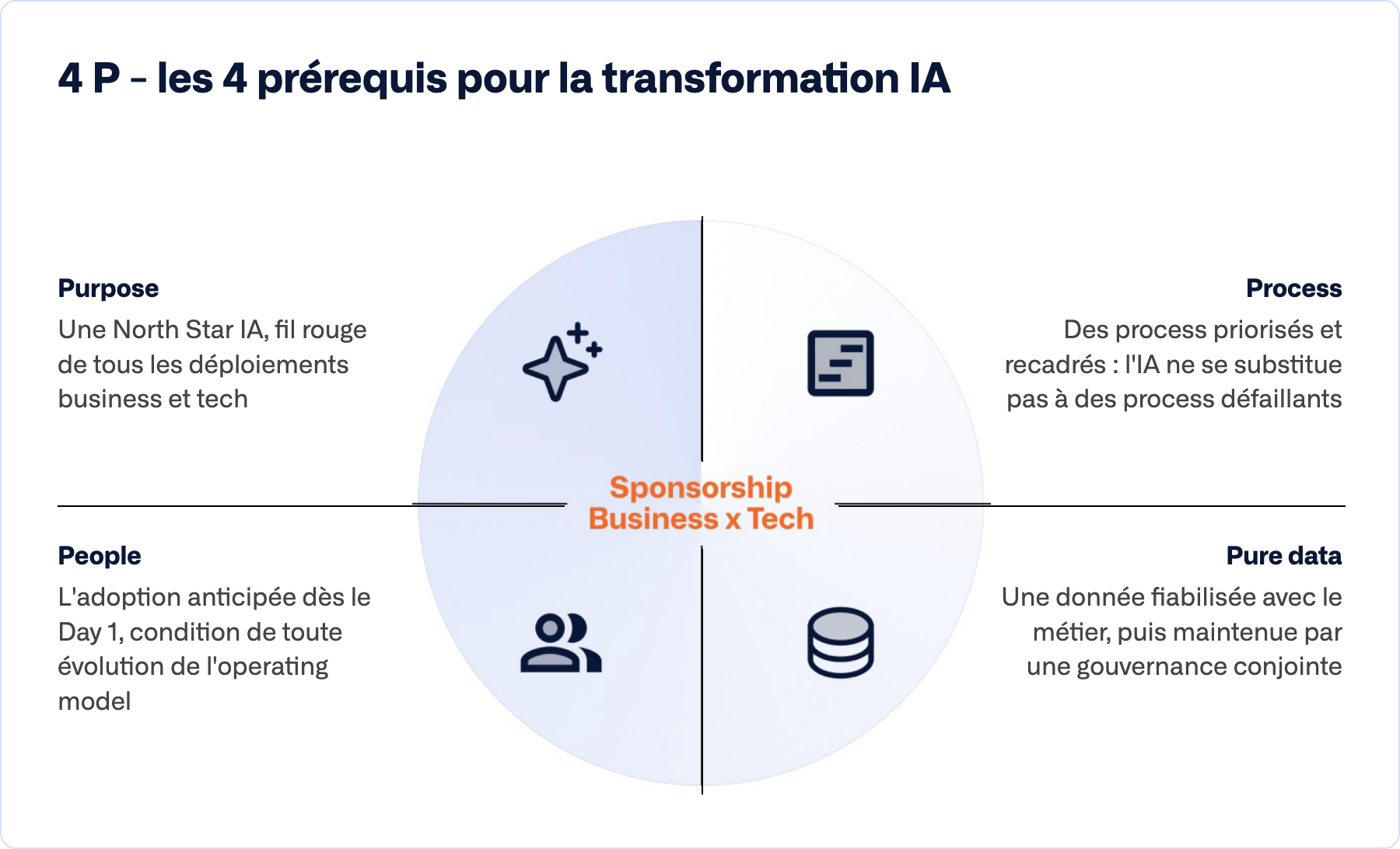
A broken process, even accelerated by AI or reinforced with fifty people, will remain a broken process. You don't need to wait until 100% of your processes are best-in-class to get started, but it is a waste of time and money to select your priority use cases without first framing your processes at a macro level.
Louis Ravier · Partner | Strategy & Performance, Constellations
We put an enormous amount of money into AI, we hit a wall because the relevance isn't there, and then we end up going back to invest in data. We would have saved time doing it the other way round.
AI Lead, Large Group - Health & Beauty
The 4 Ps in practice: what is at stake and deliverables
An AI North Star, the common thread of all business and tech deployments
Formulate the vision and the North Star underpinning the changes targeted for customers and for the company: business model, offer, target operating model, P&L impact. The AI North Star becomes the common thread of all deployments
- Vision and AI North Star owned by the ExCom
- A shared story through group communication
- Use cases prioritised by impact x feasibility, decided at ExCom
AI doesn't fix a failing process: correct and accelerate where the impact is greatest
AI does not make up for a failing process; it accelerates and optimises the processes with the most impact. Prioritisation takes into account P&L impact and time saved, professionalisation and moving upmarket, and costs - internal and external FTEs, CAPEX, OPEX
- Process prioritisation matrix
- Macro-level framing of changes to the selected processes
- Related technical and AI issues focused on the selected processes
Make it reliable once with the business, then keep data clean by design
Clean data, backed by a single source of truth and maintained by applied rules. Cleaning relies on AI as much as possible, with the business teams - Sales, Finance, Ops - who alone can settle disputed cases, sometimes down to the factories or the accounting files. The correction rules then become permanent controls, from data entry and in the flows
- Data corrected in each master data set
- Single source of truth and data lineage established
- Joint business and tech data governance
No change to the operating model without full adoption
Adoption is the deciding issue for most groups. It determines the real evolution of the operating model and the everyday take-up of the tools, the processes and the target strategy
- Transformation players identified: adoption owners, a guild of evangelists
- Coaching and hypercare on the first use cases
- Communication of the overall transformation project
- Updated job descriptions and target organisation
Use-Case Factory - a group-wide transformation programme
For three years, Constellations has supported large groups in their strategic, tech and AI transformation.
We draw on these programmes, led at the highest level, to offer a governance framework for the AI transformation. This framework is not a single method, but a set of reference points for moving from POC to an operational factory in under six months: how to structure, how to organise, how to prioritise.
Structuring the factory: three components
A Use-Case Factory is built like a Transformation Office: prioritisation at ExCom level, a body that steers and sets the pace, a shared production capacity, and a roll-out by business line. The aim is to move from POC to an operational factory in under six months. Whatever the organisation chosen, it rests on joint sponsorship, co-accountable for the result, and on three components.
1 - Business lead: a decision-making body
- Decisions owned by the business: priorities, specifications and functional requirements, ROI measurement, go/no-go
- Fast decision-making capacity: the body exists to decide, at a weekly rather than monthly pace
- Clear rituals: a living, prioritised backlog, a regular Business x Tech decision committee
- Continuous steering: pace, removal of blockers by a dedicated intervention team, planned reversibility
- An owner (sponsor) named before each launch: they are accountable for the take-up and maintenance of the use case
A complete data catalogue was configured in half a day in a test environment. The entry cost of a POC can now be counted in hours: the effort has shifted from building to take-up and maintenance
This shift changes the nature of sponsorship. Tech now knows how to build fast; only a strong business sponsor can decide priorities, appoint a relevant owner and drive adoption over time. Without that relay, this POC remained a demonstration
2 - Tech: an engine room that capitalises
- Leads delivery: build and industrialisation of use cases and agents, quality, security, debt
- Creates reusable assets and shared guardrails: components, prompts, connectors, evaluations, a trust protocol. This is what makes it possible to do something a hundred times instead of once, and what distinguishes a factory from a series of POCs
- Documents the context: descriptions, glossary, business rules. Documentation is as much a performance lever as a cost lever and a governance obligation
- Ensures a 360 view of AI tools and uses: to safeguard architecture, security, consistency of use and cost control
- Runs a single pipeline: framing the expected result, scoring, design, build, evaluation and pilot, decision, industrialisation and handover
At a European telecom infrastructure operator, we measured the effect of documentation on the reliability of a natural-language analysis agent. With identical questions and tooling, the share of correct answers rises from 40-60% with the semantic layer alone to more than 80% once a context layer is added: descriptions, glossary, business rules. The agent improved faster with the maturity of the documentation than with new model versions
The procedure is the asset, the prompt is disposable. A model can be replaced in a few weeks; skills, controls and context are the anchor point.
Aurélien Rayer · Partner | AI, Data & Tech, Constellations
Key success factor: stay model-agnostic. Model-independent assets (reusable skills, pre-production controls, documented context, evaluation sets) concentrate the learning and remain the client's property
3 - Change & adoption: a guild
- The North Star and the company project at the centre: AI presented as a shared objective, carried by the whole company
- A network of evangelists: a group-wide guild, the people arm of the factory
- Coaching rather than training: coaches who hold the pen on the first use cases, in hypercare mode, then support the move to scale
- New skills: the groups furthest ahead on AI adoption are introducing assessments of the AI skills essential to their model, on the Business side and the Tech side
- Documentation as a vehicle for passing on knowledge: AI makes documentation both more complete, because it costs little to produce, and far more accessible, because anyone can query it in natural language instead of reading through it. The team's knowledge no longer depends on a few people (or on outsiders!)
Coaching rather than training. A day of training doesn't bring people up to speed, it's like Excel. You need coaches who hold the pen on the first use cases, then learn how to scale.
Performance Director, Mid-cap - Industry
Within a data team, two unexpected effects were observed
- The first is induced upskilling: with the agent producing the first draft, practitioners spend more time reviewing, checking and deciding than writing. They thus exercise, earlier, a judgement usually reserved for senior profiles, provided the review stays systematic
- The second is better knowledge transfer: documentation, now cheap to produce, is written systematically and kept with the code. Context no longer depends on the person who created it, and the team's memory becomes collective
Organising the factory: two axes, four archetypes
A Use-Case Factory borrows most of its functions from the Transformation Office: company-level prioritisation, a body that steers and sets the pace, a shared production capacity, a roll-out by business line. The form it takes depends on the organisation it sits in.
- The make-up of the Use-Case Factory: Business lead, Tech Engine room and Adoption, integrated or separated
- Its position in the organisation: ExCom level or BU level
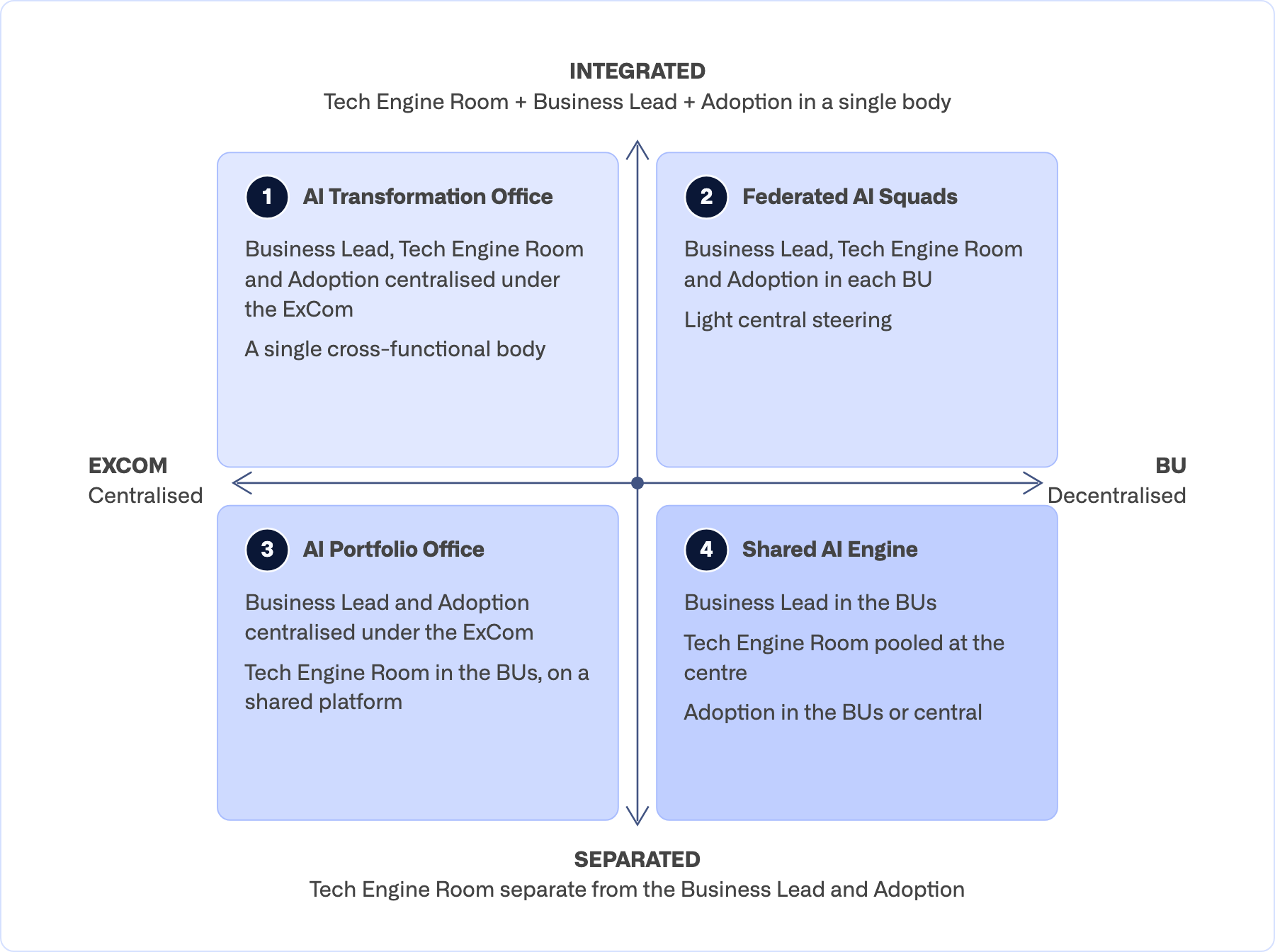
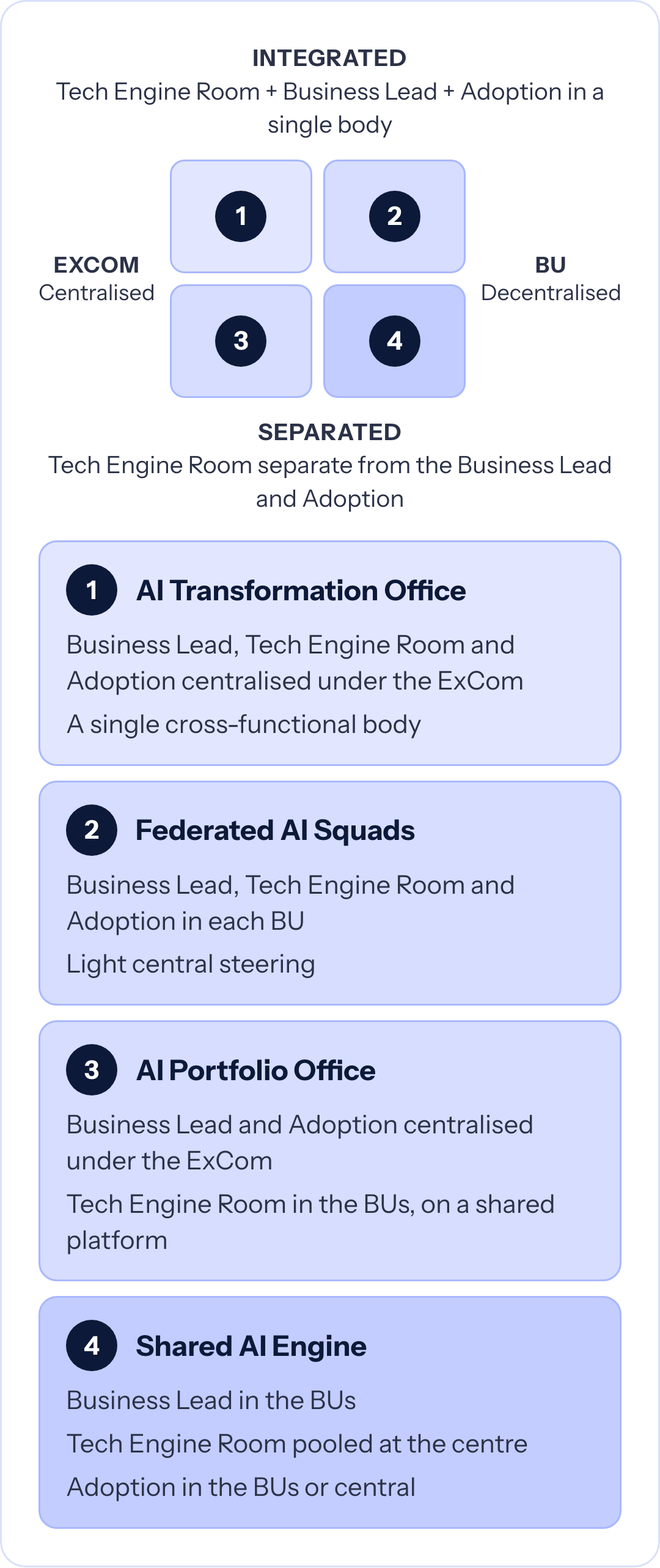
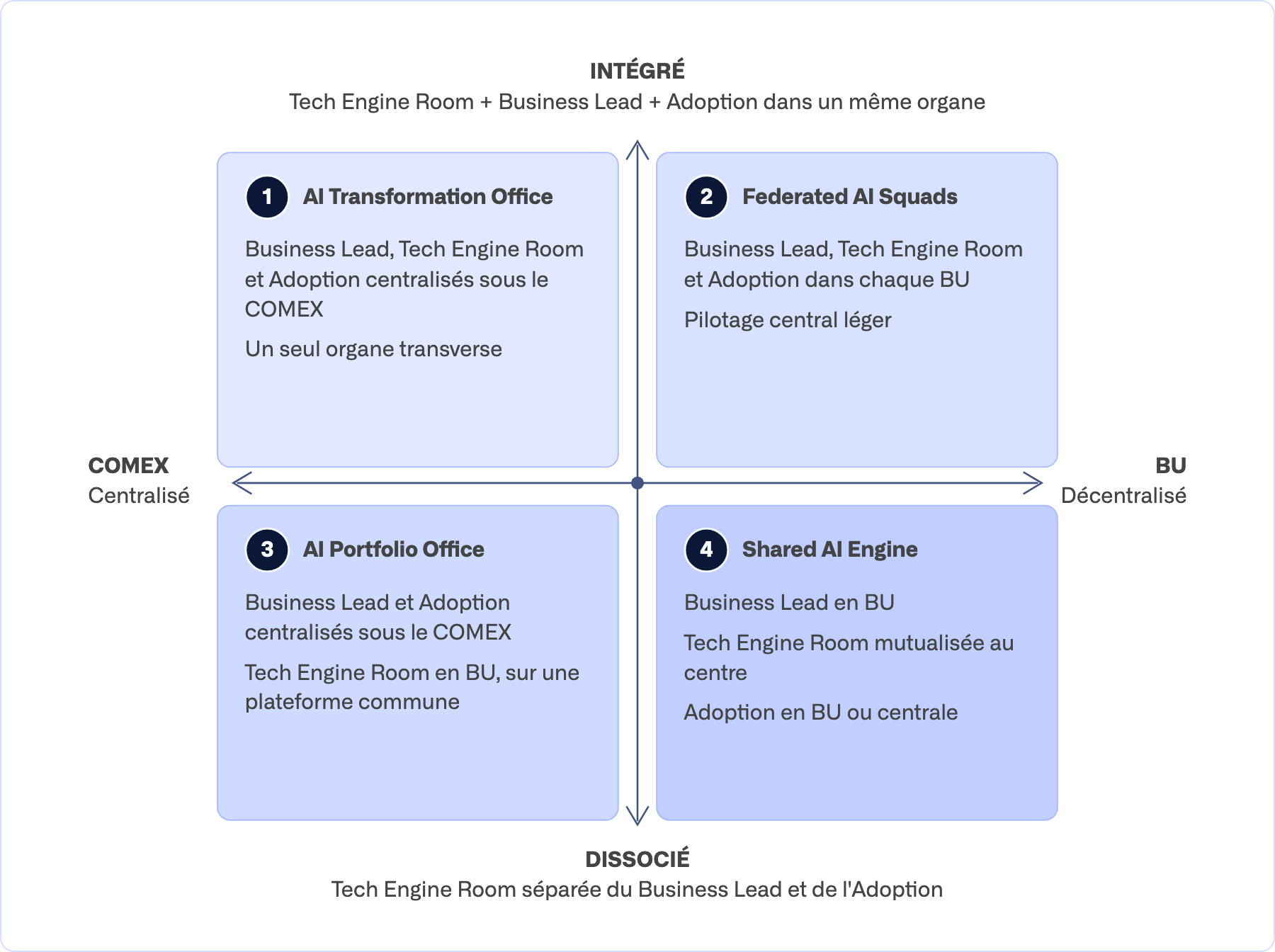
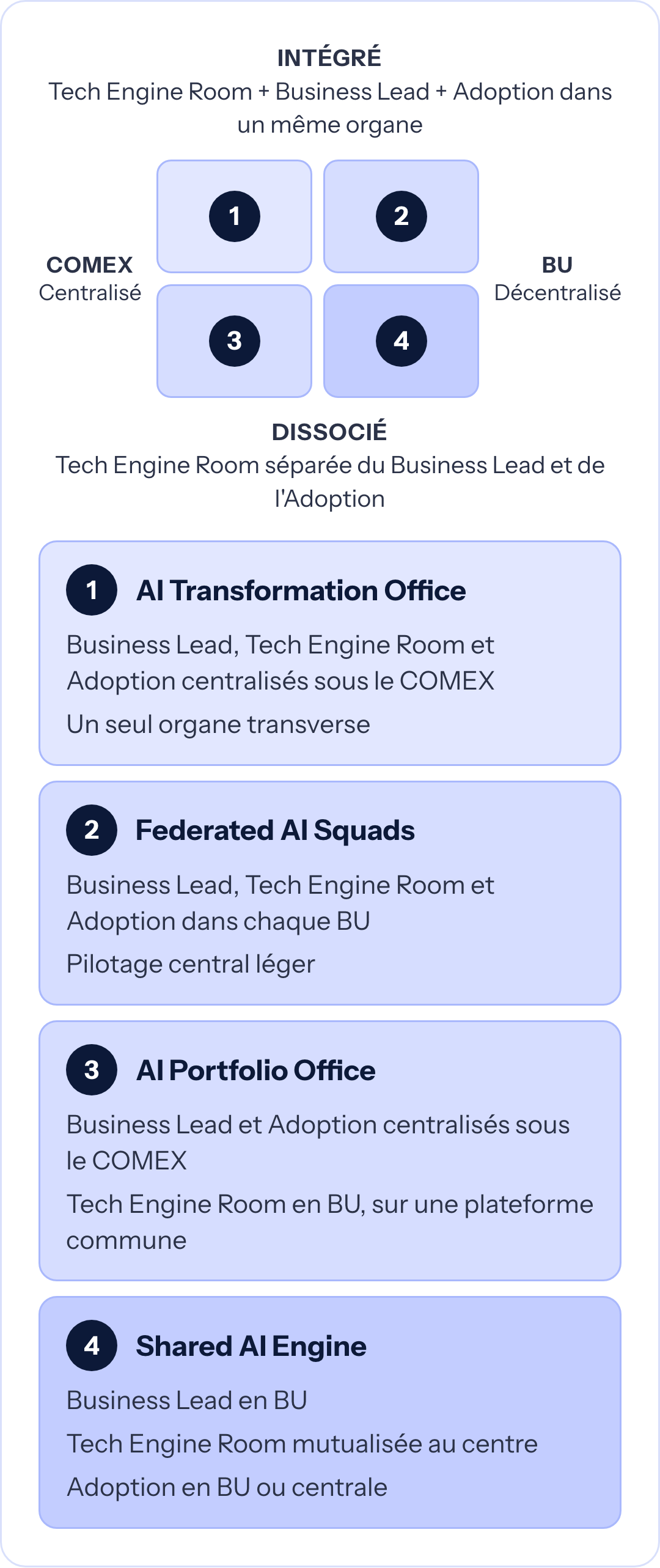
No archetype is universal. Each one answers a particular organisational set-up, and can evolve with its needs.
In practice, mid-caps and launch phases lean towards a centralised factory (archetype 1); multi-business large groups often converge on a light central hub with relays in each BU, whose decision-making stays central to avoid fragmentation.
1 AI Transformation Office
A single body, attached to the ExCom and cutting across the BUs, brings together Business lead, Tech and Adoption.
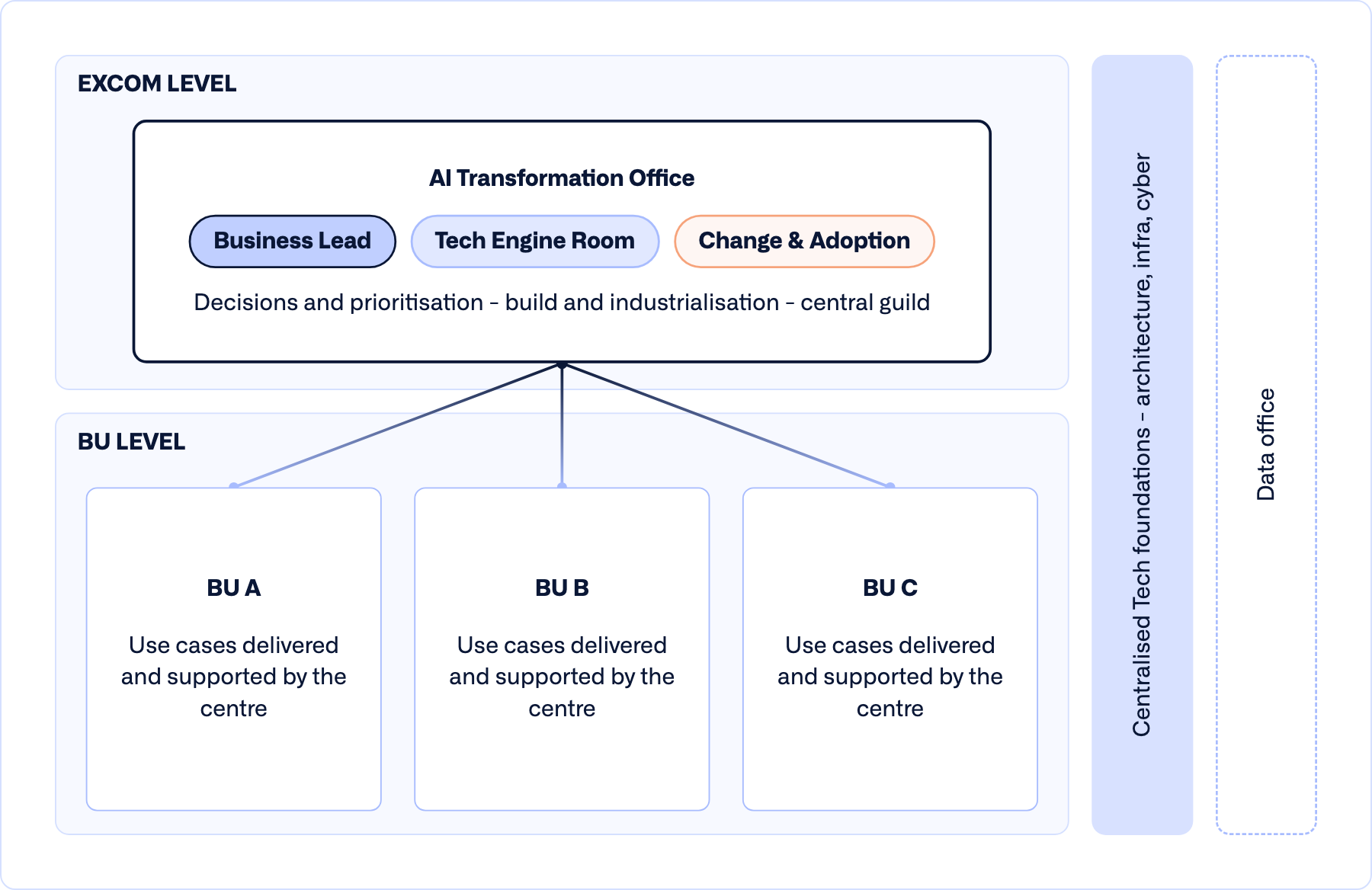
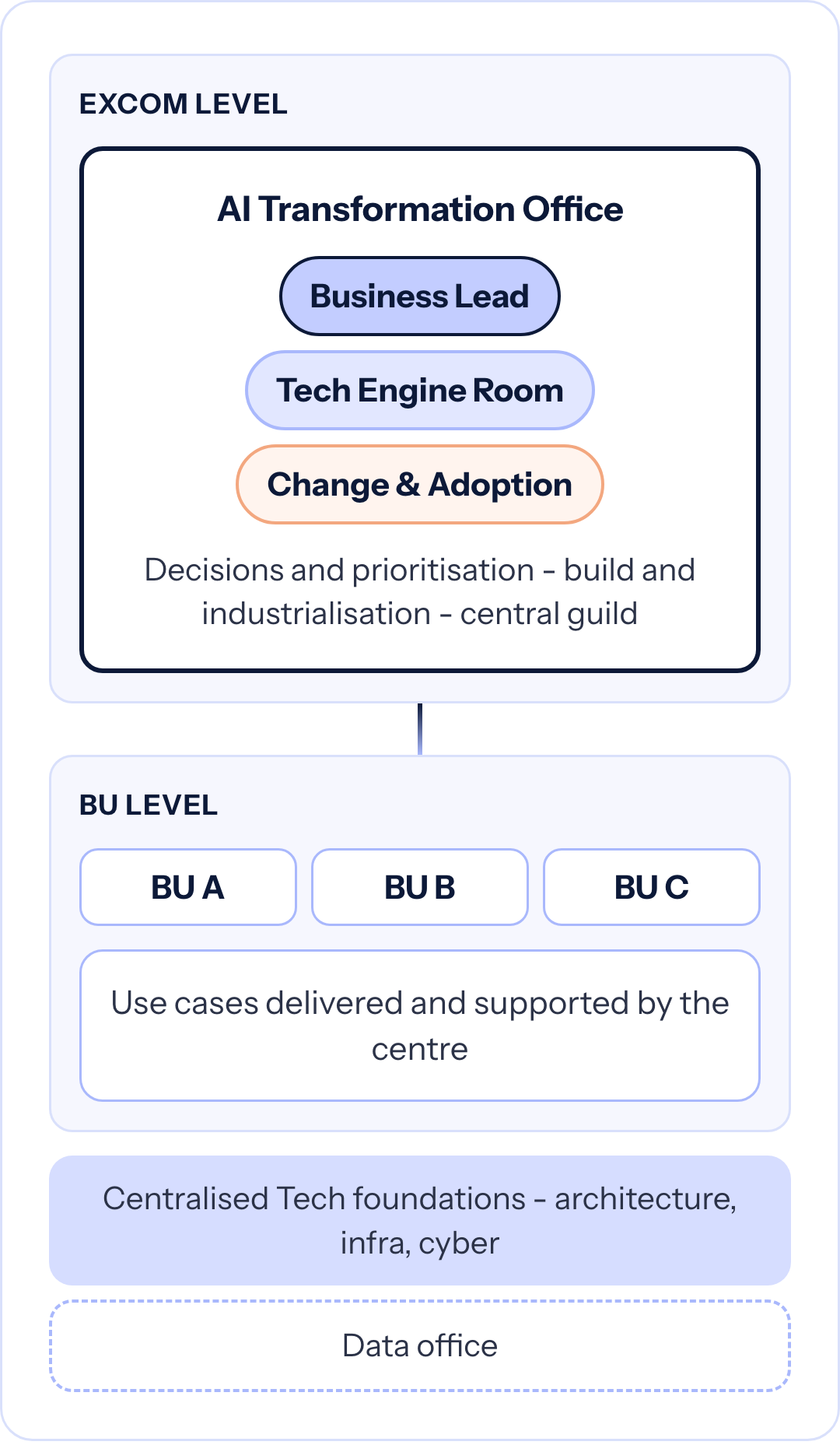
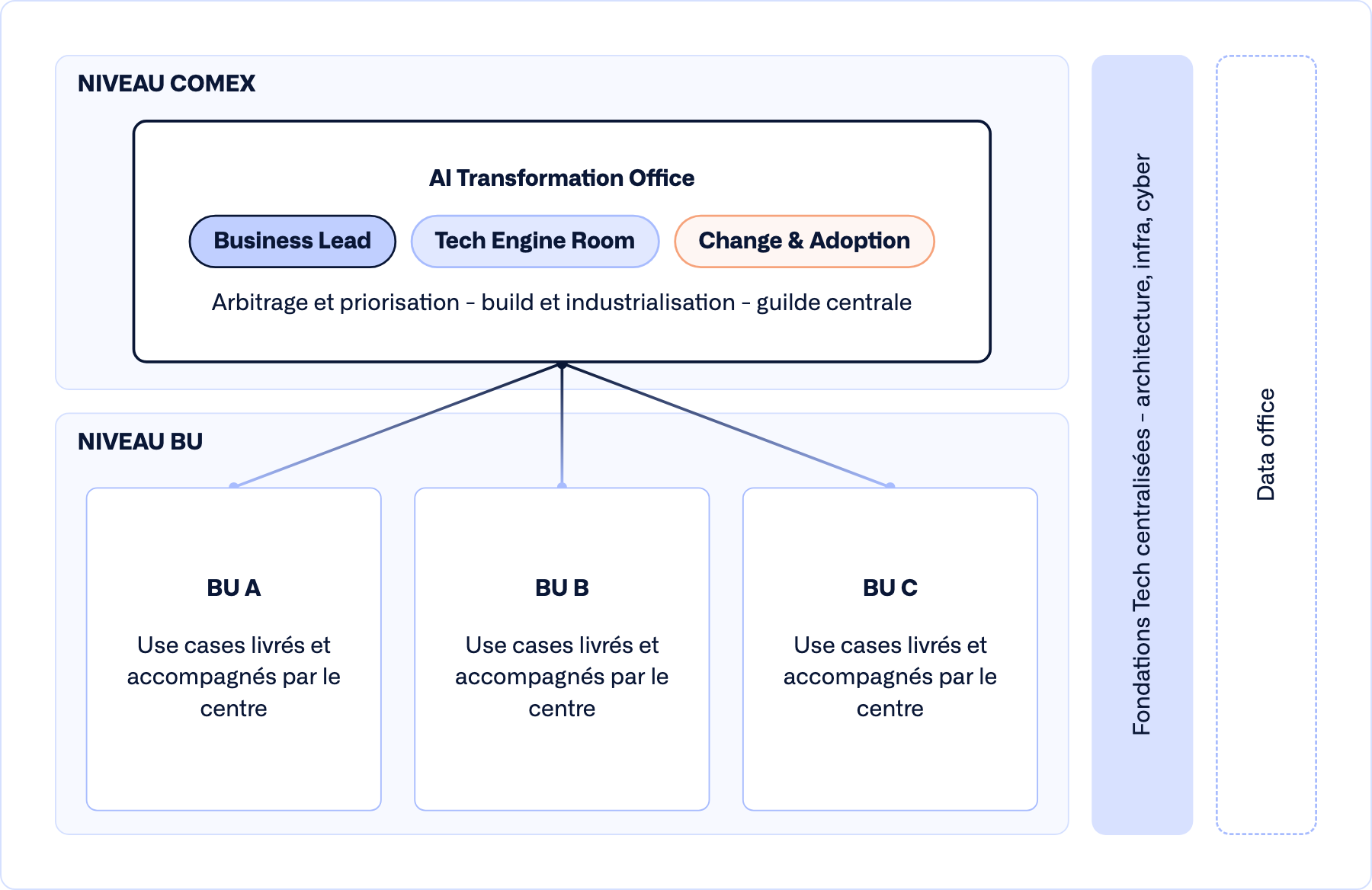
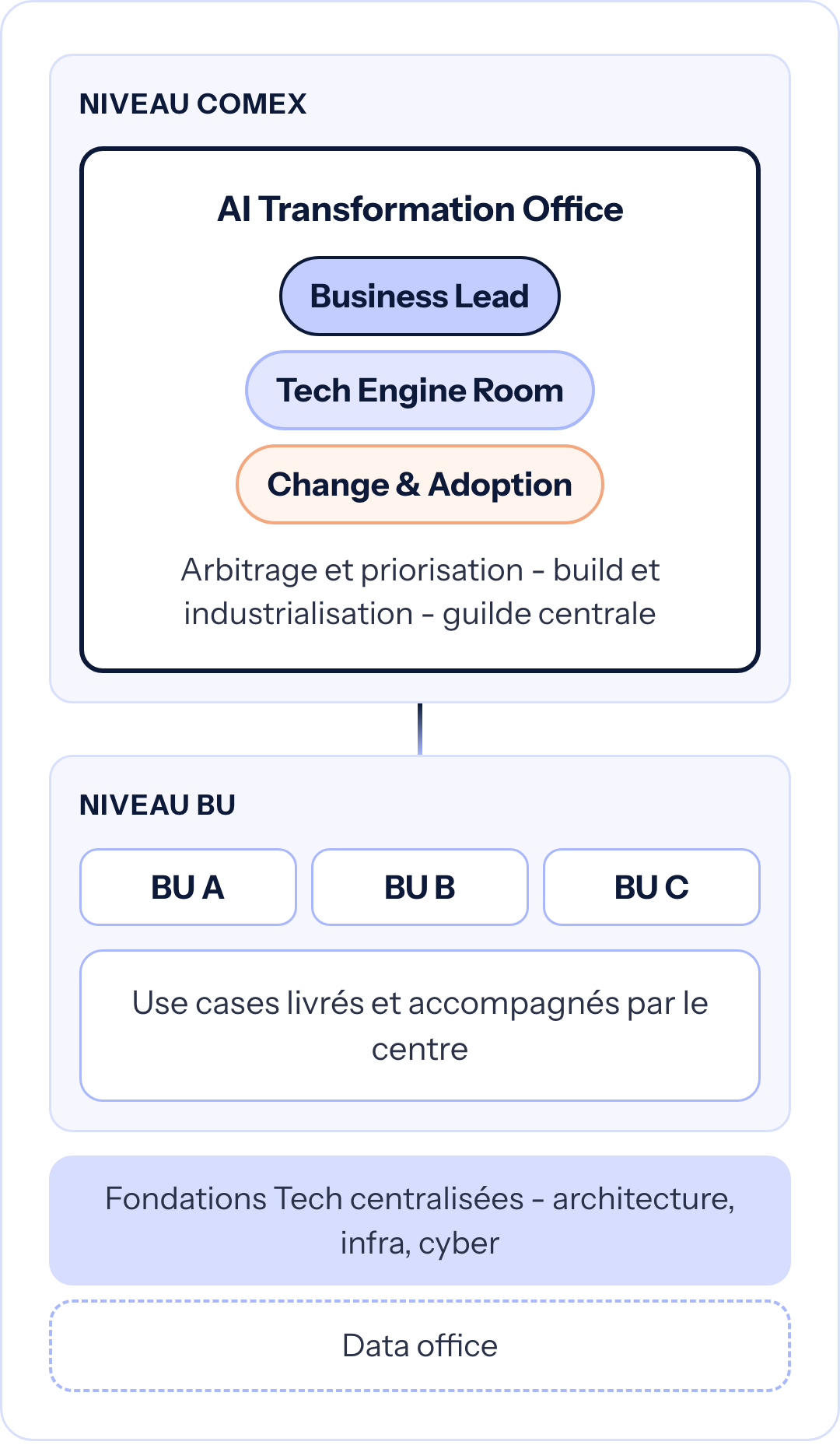
Who it suits: Mid-caps and large groups with few silos, used to steering transformation at ExCom level
- Effective prioritisation at company level
- Functional trade-offs settled at the highest level when needed
- Constant alignment with the North Star and the strategy
- Reliance on best practices to build skills faster
- Control of Tech and Change budgets
- Assumes strong proximity and leadership from the sponsoring business leads towards the BUs
- In large groups, leaves the BUs less agility
2 Federated AI Squads
Each BU has complete squads that carry their use cases end to end. A simplified steering layer carries common standards, the allocation of budgets by BU and the tracking of the transformation.
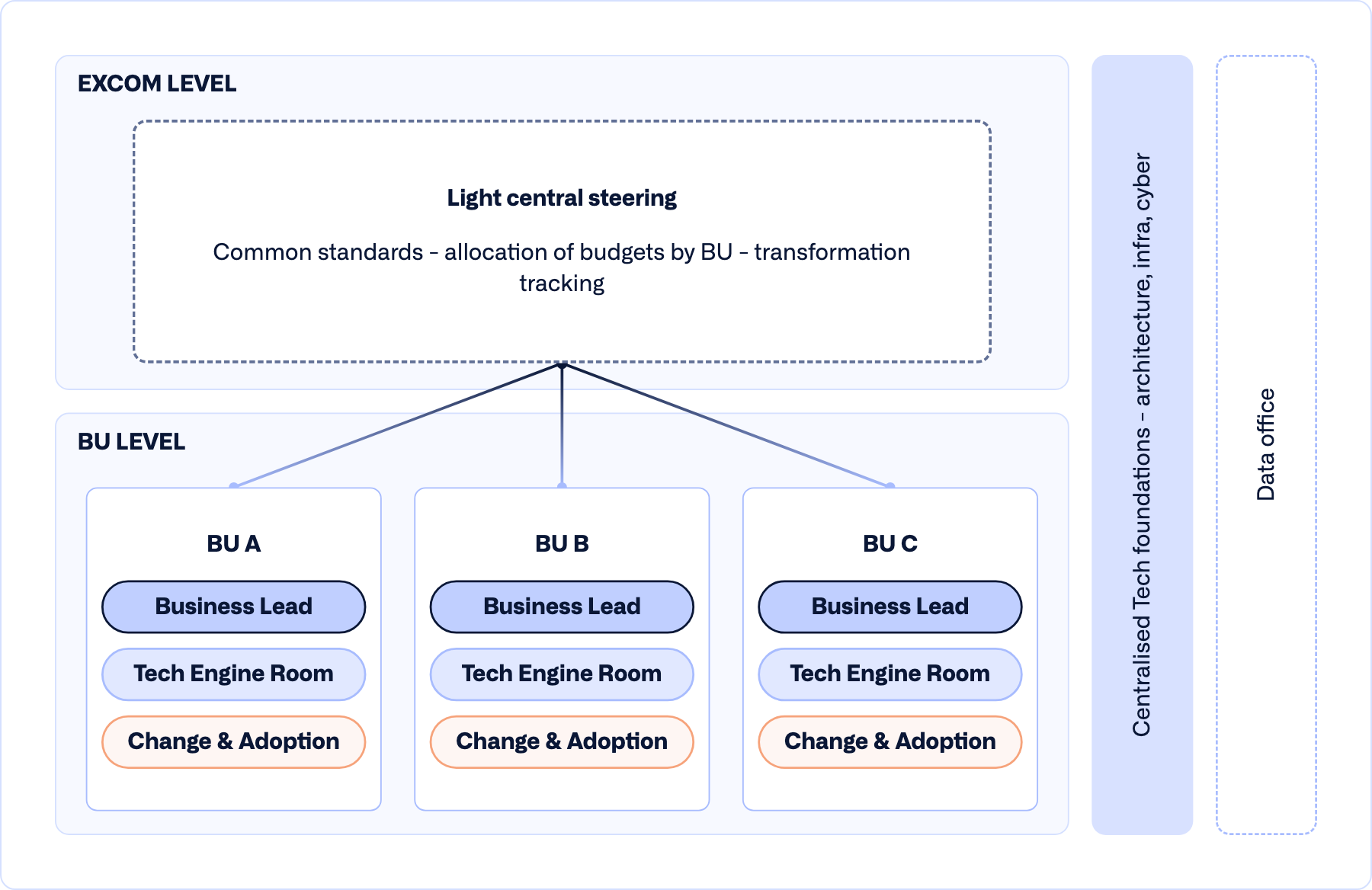
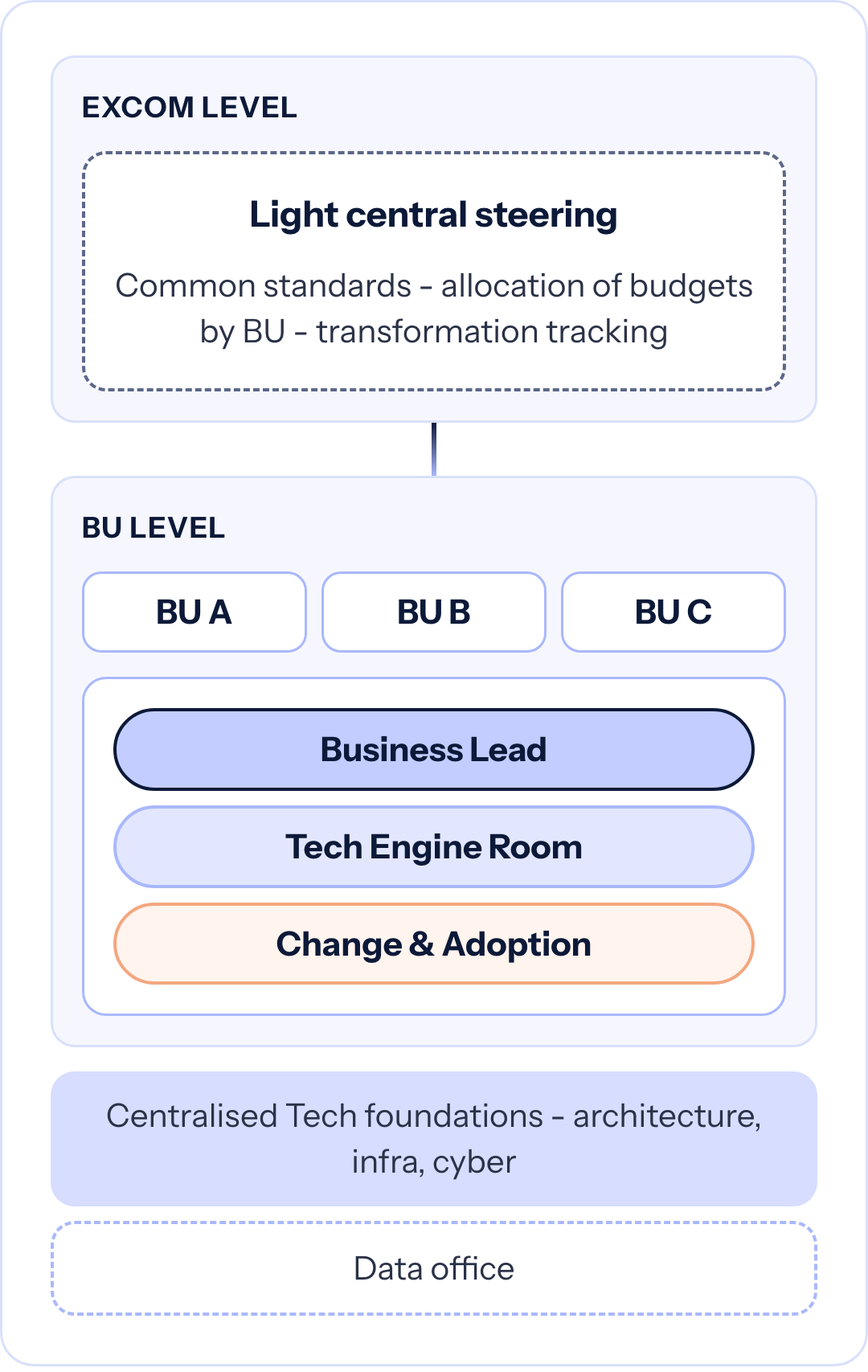
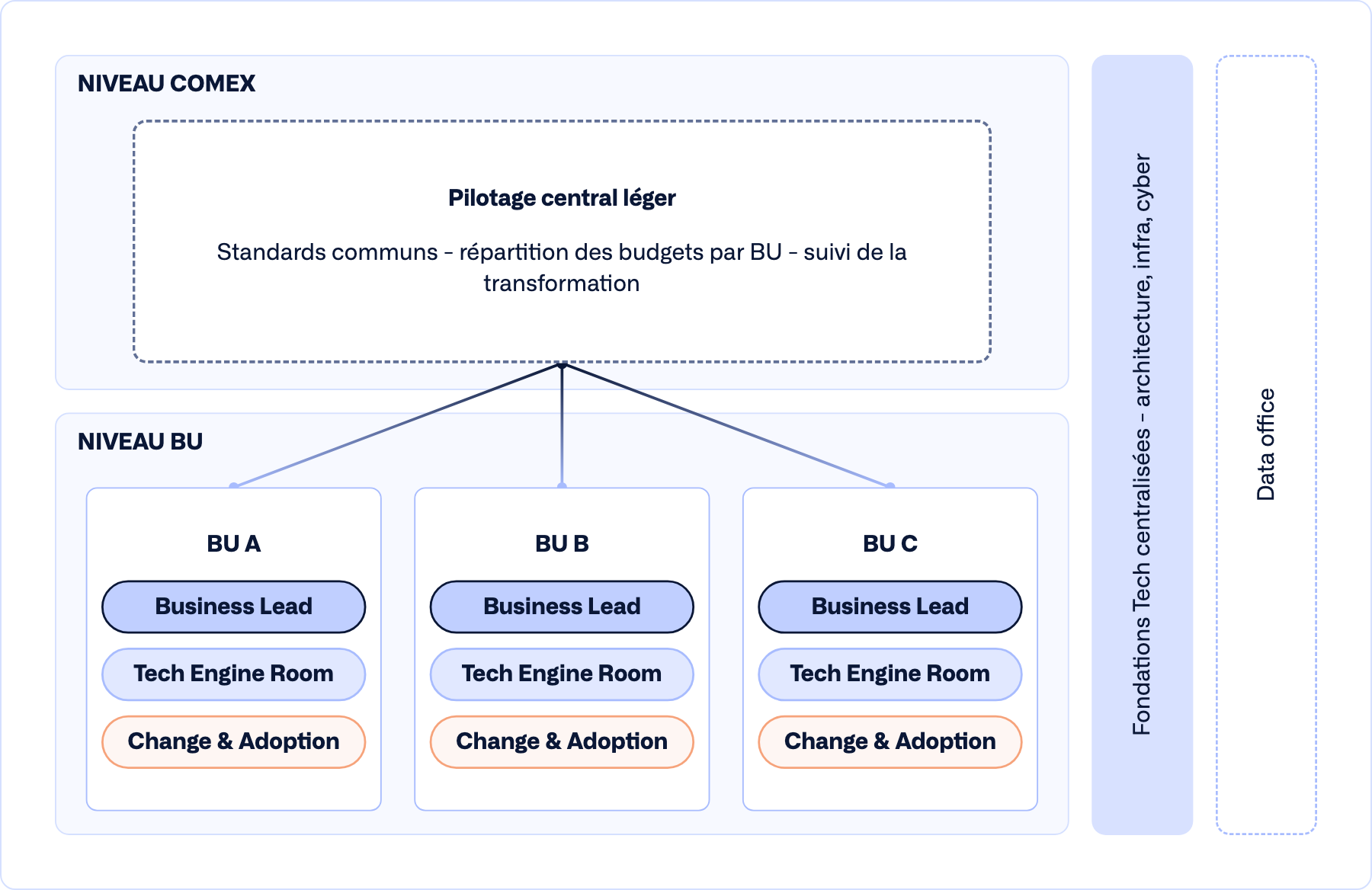
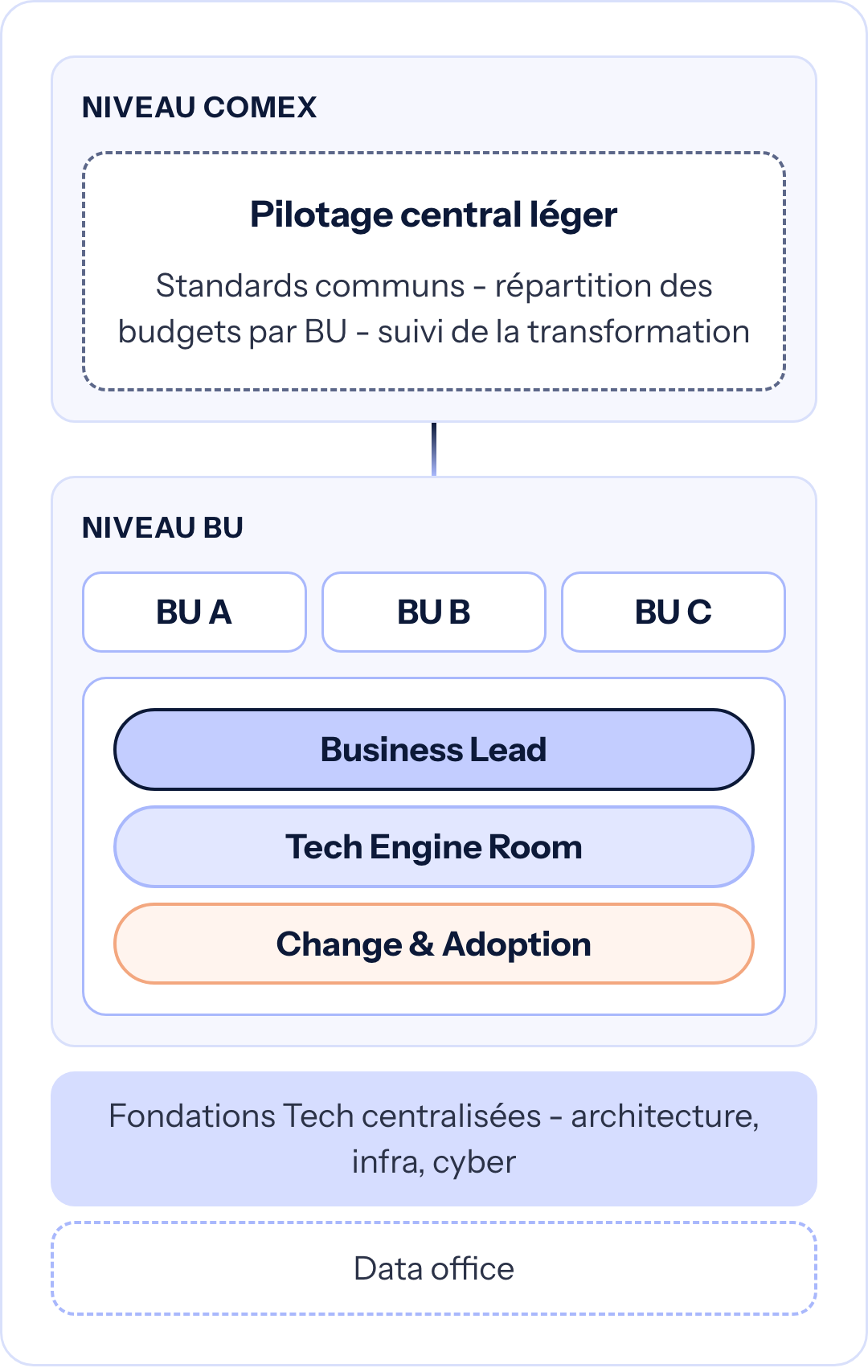
Who it suits: Decentralised groups, with autonomous BUs equipped in Data and Tech
- Decisions and prioritisation within each BU
- Proximity and speed of execution
- Clear accountability for each BU's P&L
- Duplicated effort
- Costs that are hard to govern
- Group priorities poorly carried
- Skills building and sharing of good practice more difficult
3 AI Portfolio Office
Business lead and Adoption are carried at the centre. Tech is delivered in the BUs, on a shared platform and under a central design authority.
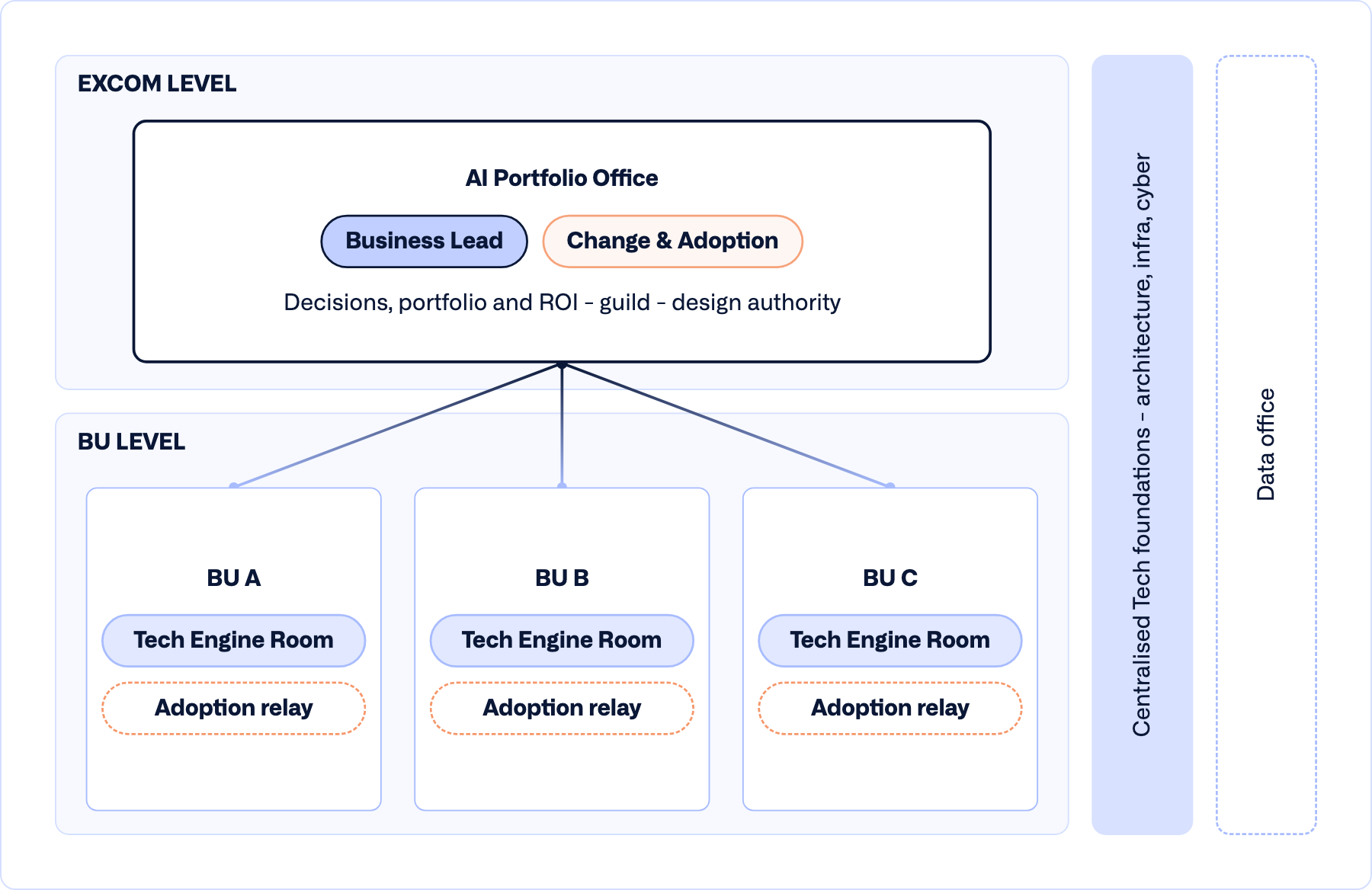
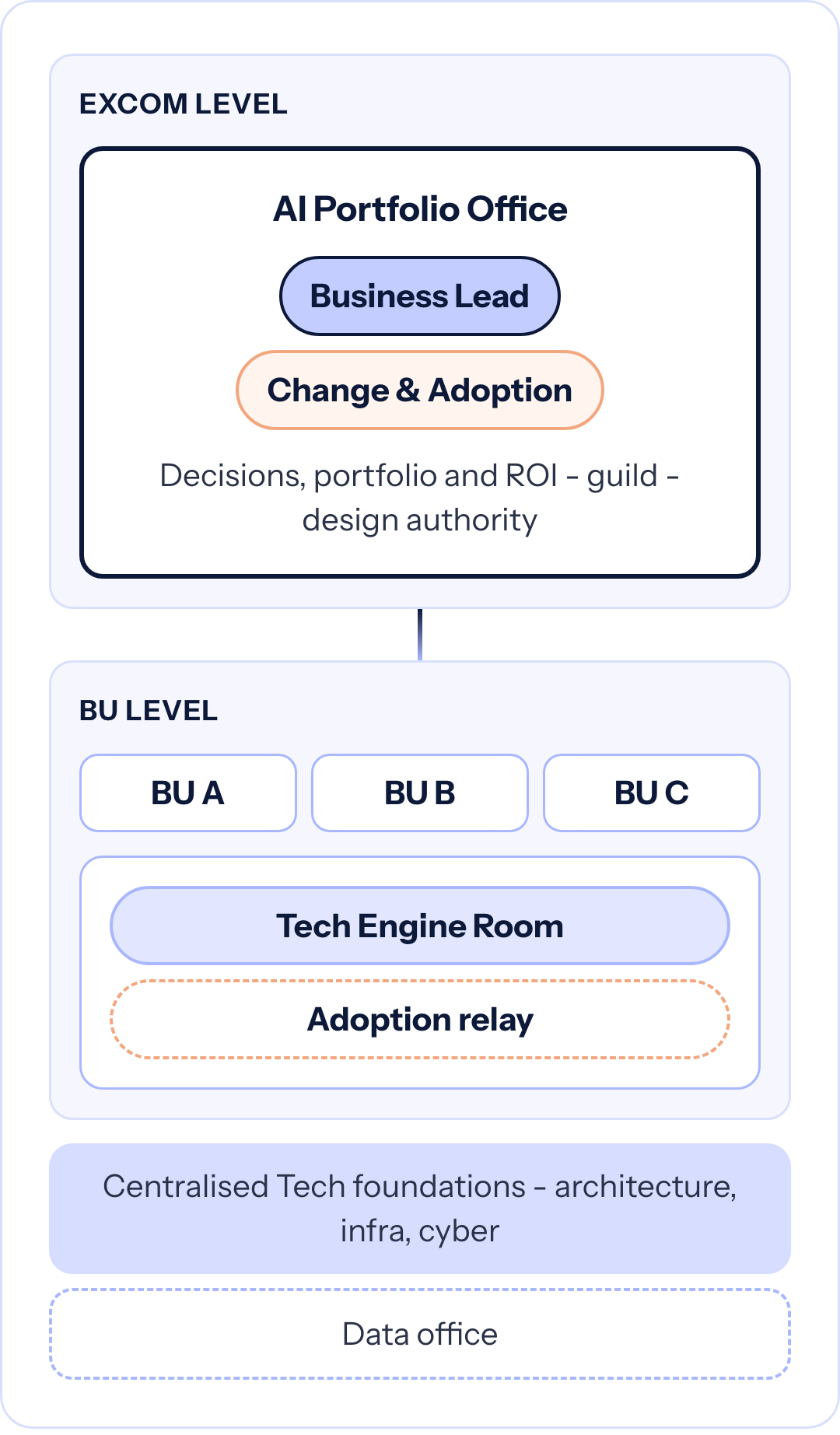
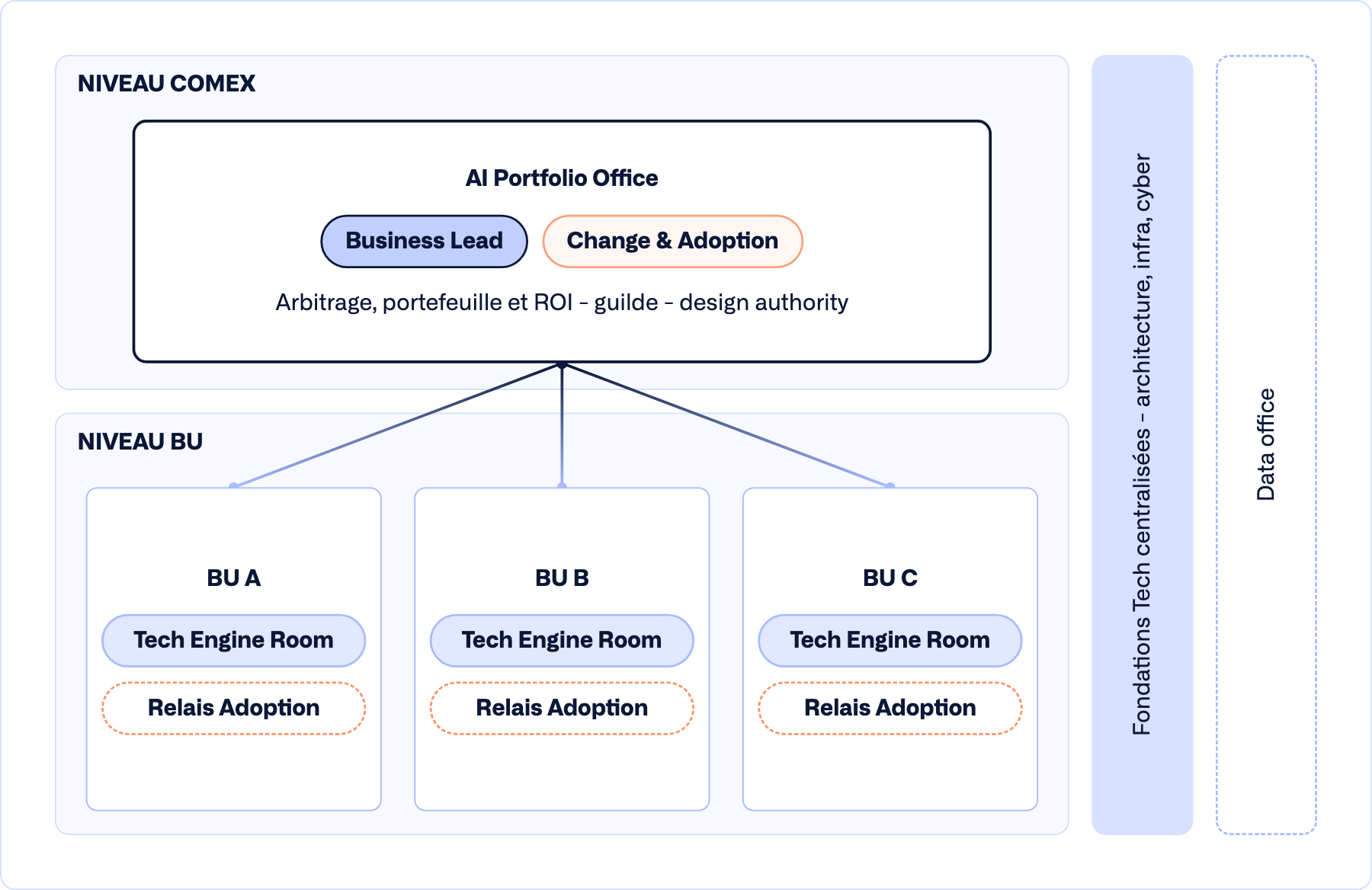
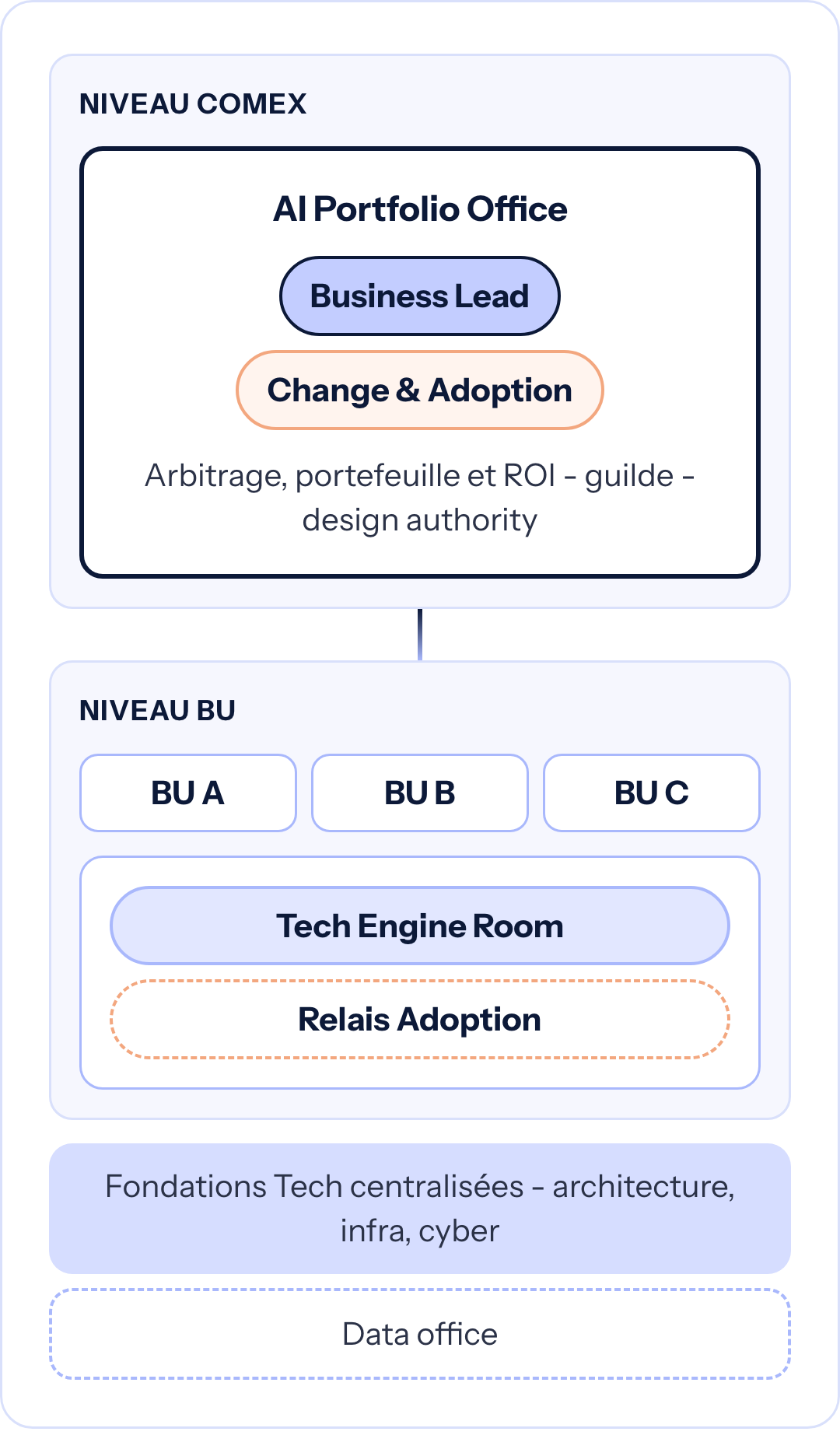
Who it suits: Highly decentralised groups where decision-making discipline and alignment with group strategy have yet to be established. Very tech-driven organisations, scale-up style
- Tech Engine Room at every level, while keeping overall strategic alignment
- Change and Adoption steered at the centre: best practices, budget control, prioritisation of effort
- Production close to the field
- On the Business Lead side, staying close to BU and field priorities
- Business / Tech interfaces harder to manage
- Heterogeneous Tech Engine Rooms across BUs: the design authority's role must be guaranteed
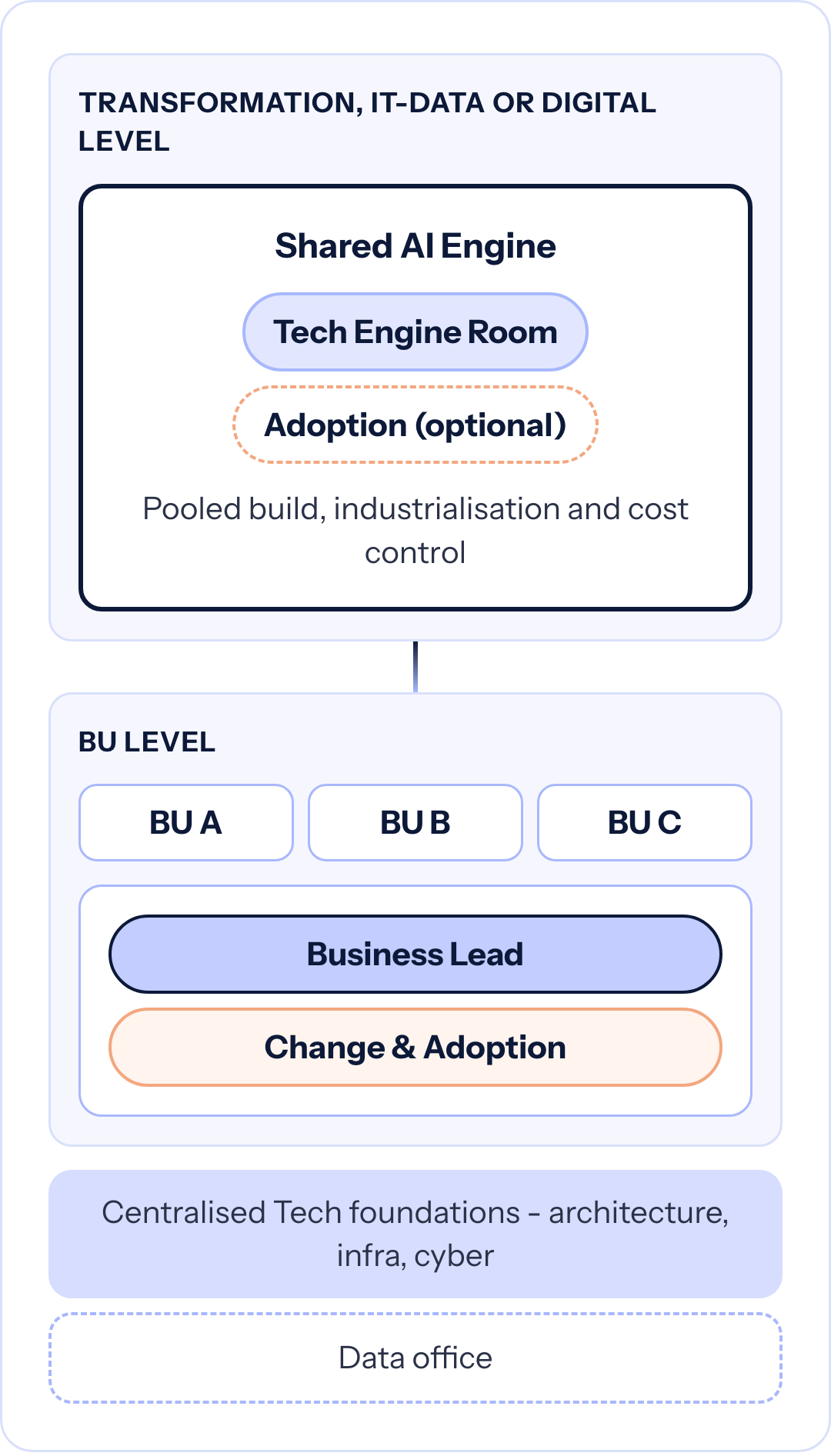
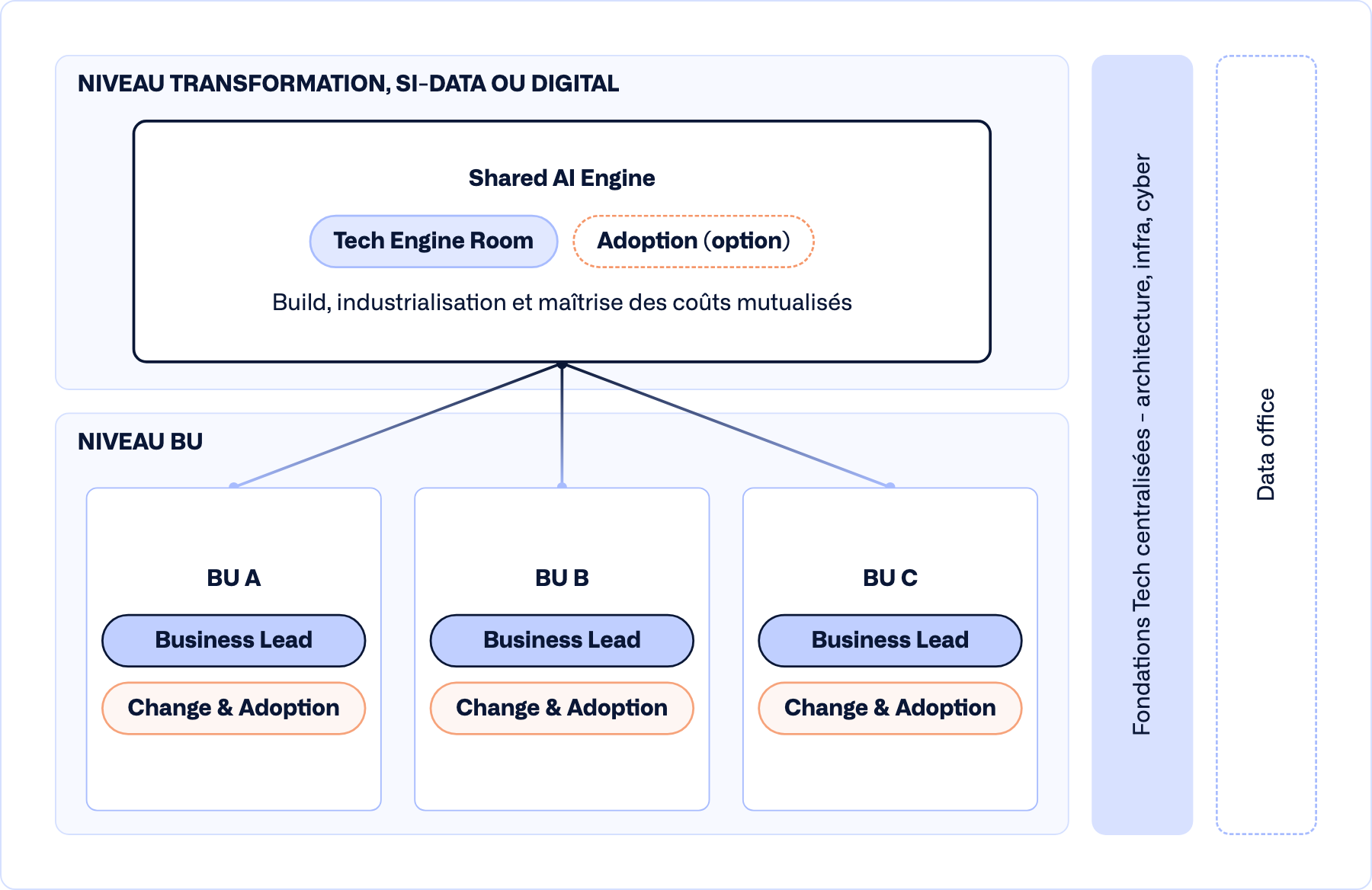
4 Shared AI Engine
Tech is pooled at the centre. The BUs carry the Business lead and, most often, Adoption; this can also be entrusted to a central guild attached to the platform.
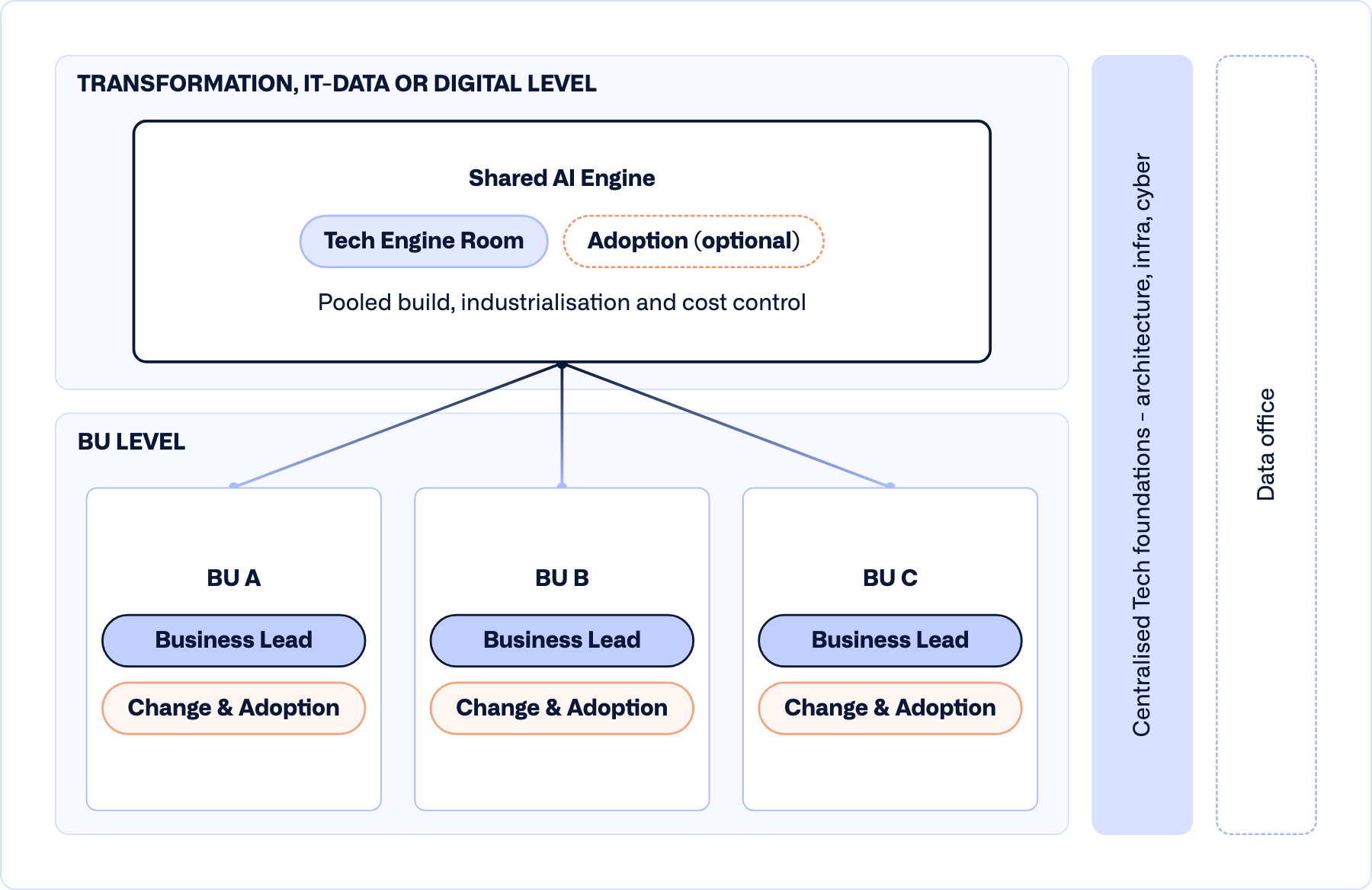
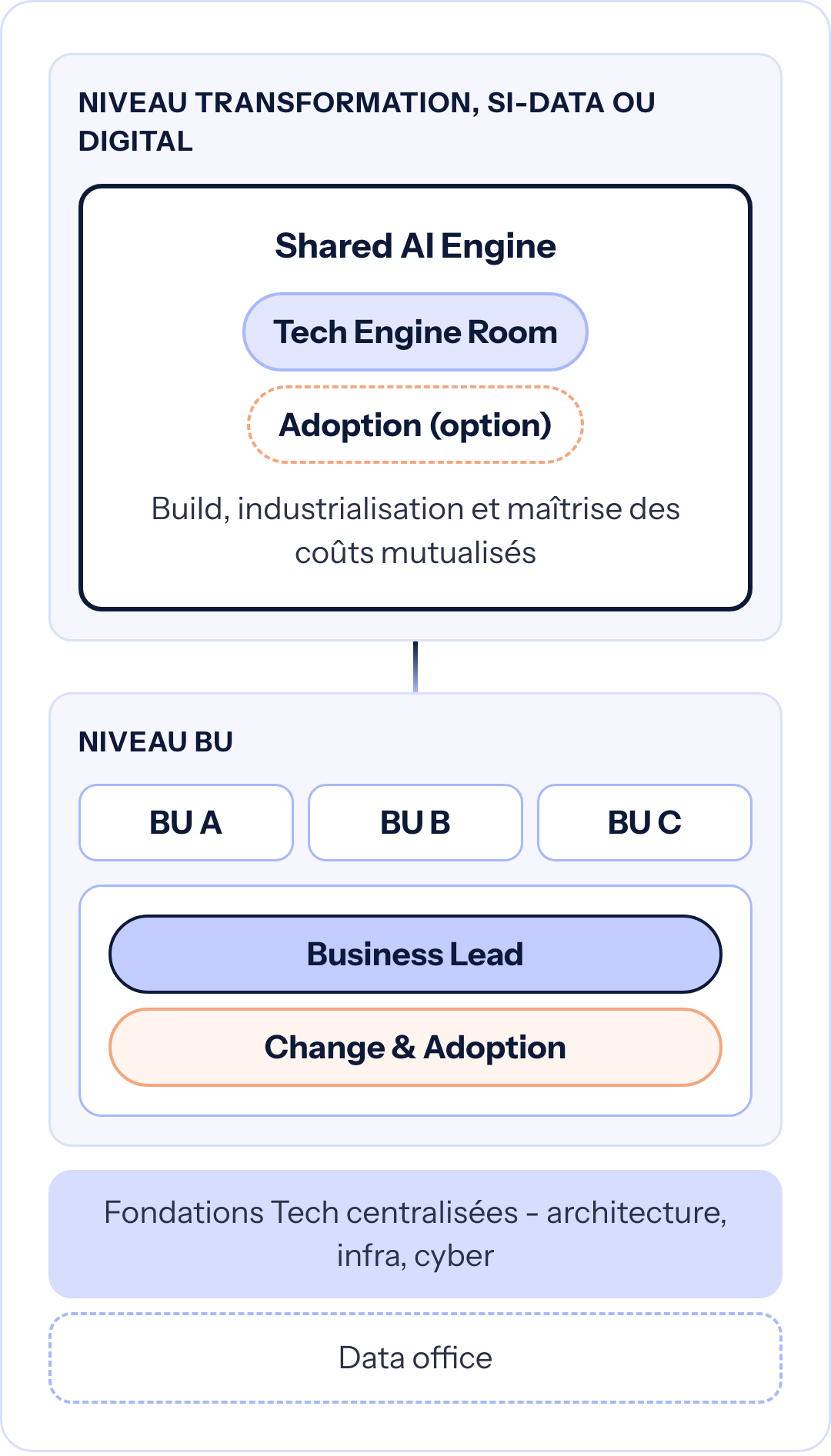
Who it suits: More traditional organisations, with a strong IT department that is hard to replicate in the BUs, and highly autonomous BUs with strong business ownership
- Functional trade-offs and prioritisation as close to the field as possible
- Consistent build and reuse of assets
- Business accountability for results
- Tech Engine Room in an order-taker position
- Capacity conflicts between BUs: requires an explicit allocation rule
- More complex BU x Tech steering: rituals to adapt accordingly
Zoom - Productivity levers in the age of AI: concrete cases
The value of AI on a process breaks down into four levers. The first two save time, the last two ensure quality and simplicity.
Four value levers on a process
Repetitive, high-volume or rule-based work is handled end to end; human time is redeployed to the cases that require judgement
Remove interfaces and re-keying, handle more volume at constant quality, and above all unblock the bottleneck that slows the whole chain
Controls happen as you go, within the task itself. Errors are corrected as they appear, saving the audits, rework and back-and-forth at the end of the chain
AI absorbs unstructured formats and exceptions that classic automation could not handle
Most pilots chase only the second lever, speeding up what exists. Lasting gains come from reading all four.
When you put a process through the four levers, most of the value is often hidden in a step nobody had targeted: an interface to remove, a control to build into the flow, a deliverable that has become useless. The best results come from teams that look there before speeding up what exists.
Enguerrand Hurstel · Partner | Digital, Marketing & Customer Experience, Constellations
This framework is not new: strategy consulting firms have used it for decades to break down a process. We have adapted it to the considerable changes made possible by AI, and above all documented it with concrete examples from our AI transformations with clients, in France and in Europe.
Where AI creates value on a process
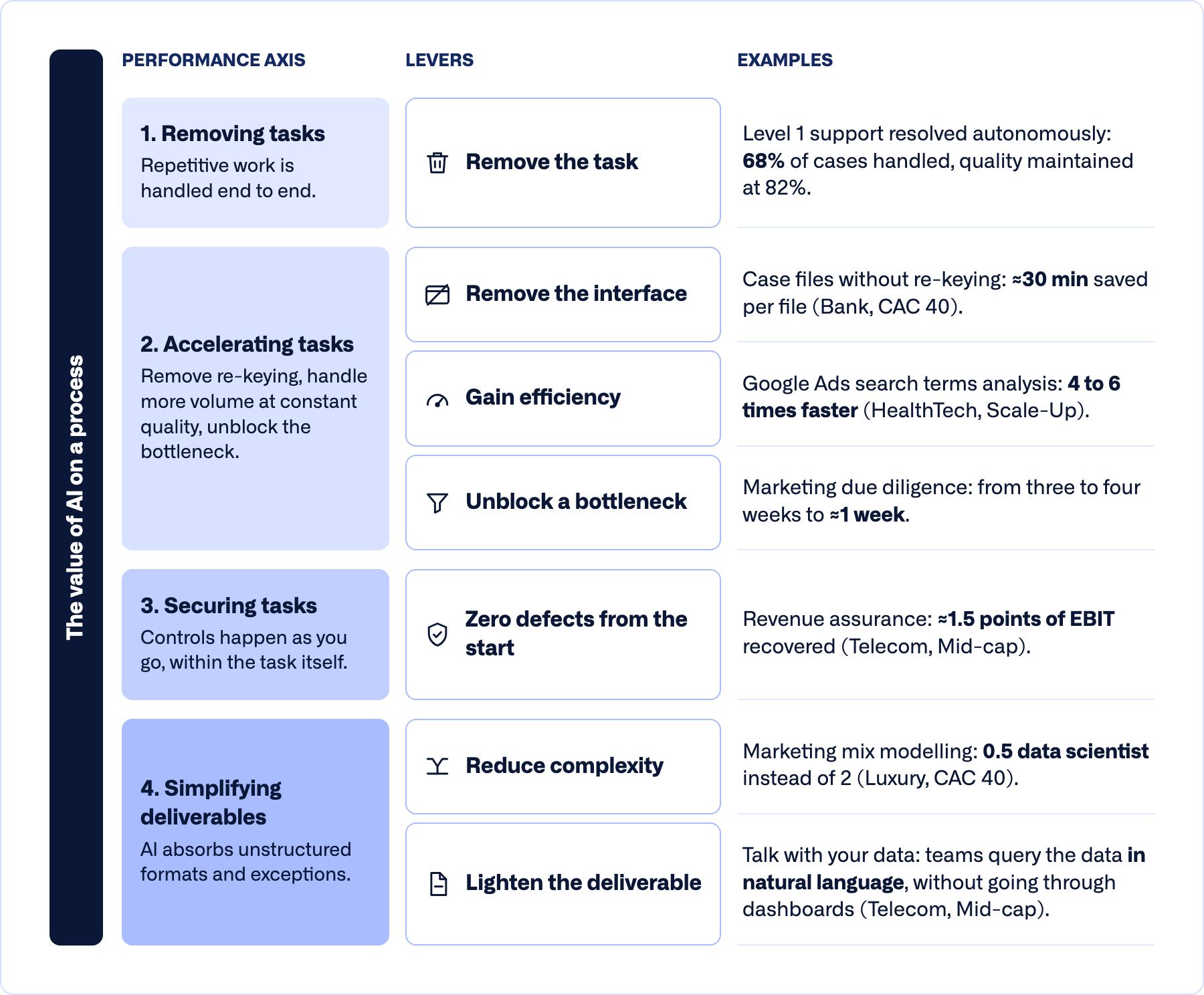
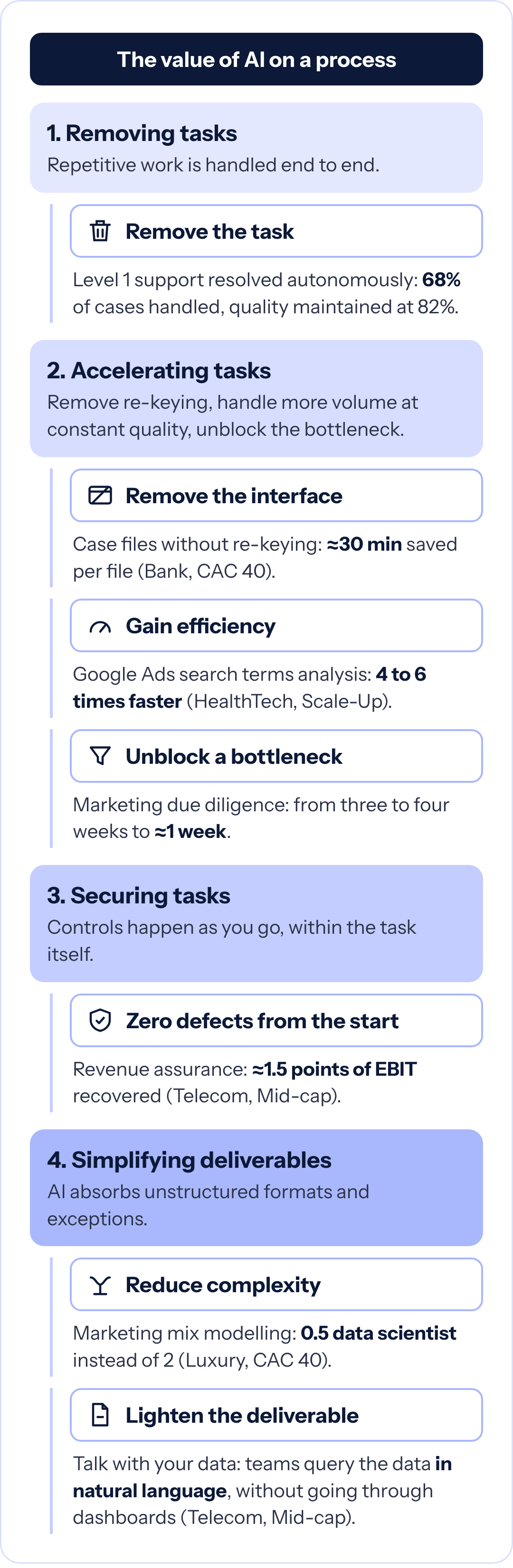
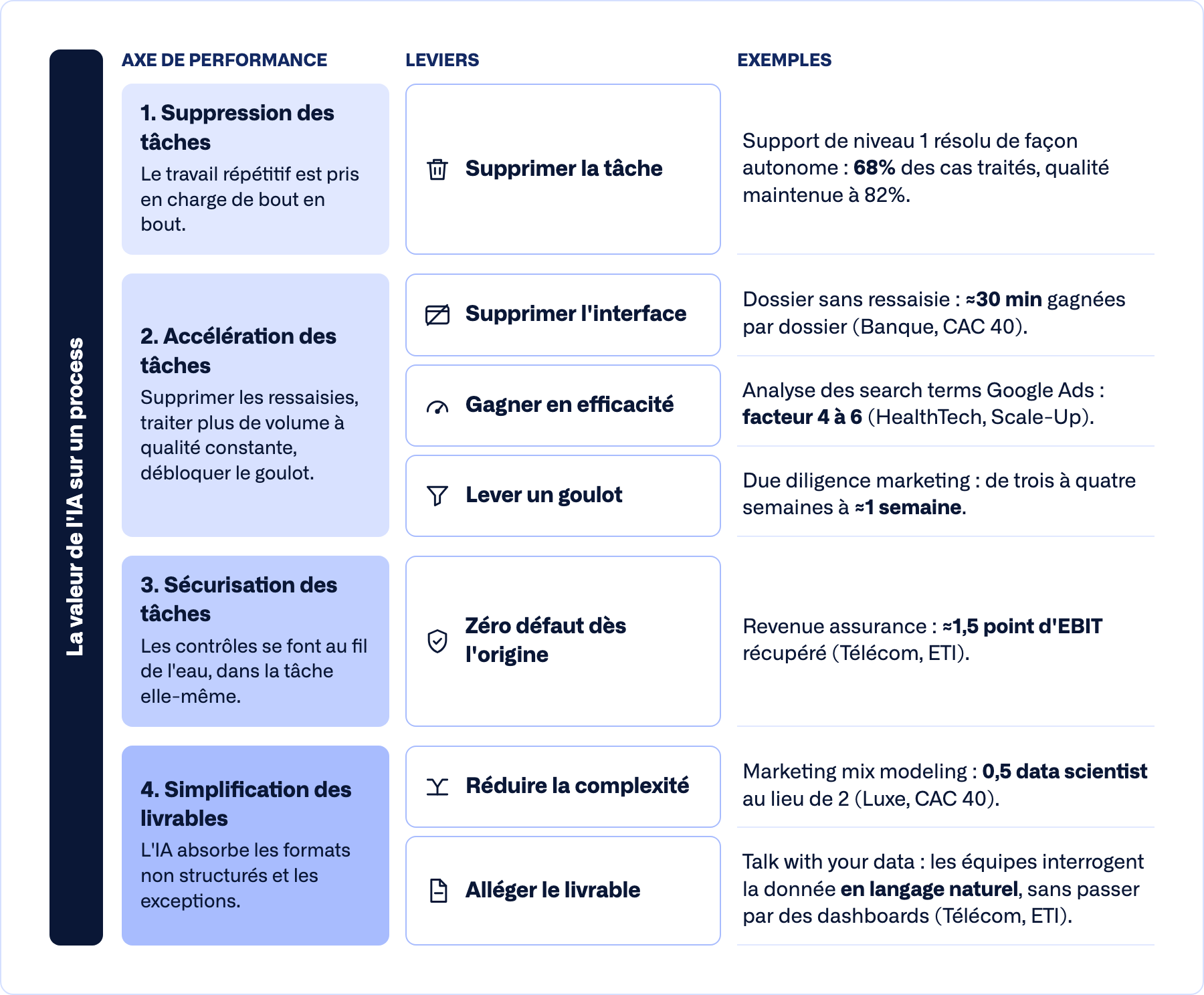
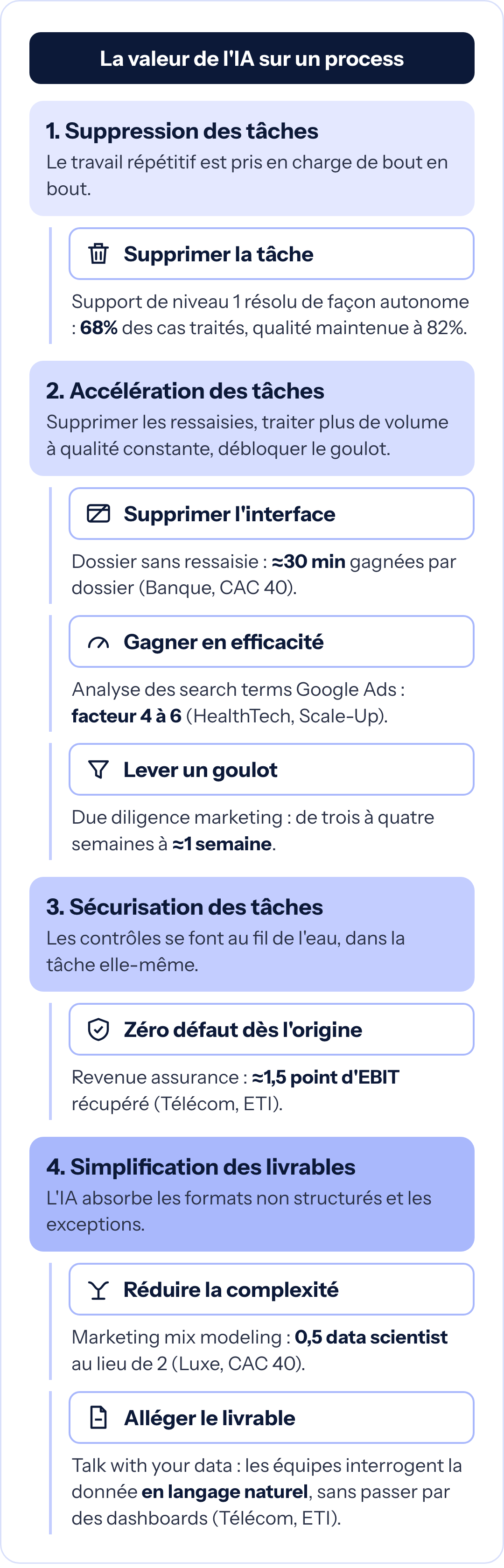
The following pages detail each of these levers, then present the concrete use cases identified, function by function.
Removing tasks
AI handles repetitive, high-volume or rule-based work end to end, and redeploys human time to the cases that require judgement.
Accelerating tasks
Remove the interface. AI absorbs the translations, re-keying and hand-offs between two steps or two systems. It reduces breaks in the flow and brings the input straight to the expected result.
- AI shortens the distance between intention and action. The interface becomes conversational, contextual, sometimes invisible
- AI puts in the hands of the Business the ability to technically build first POCs, to save time in exchanges with Tech
Gain efficiency. This is often the first lever activated, because it can be anchored in existing processes. AI makes it possible to handle much more volume in the same time, by reducing the time needed per operation and increasing the overall capacity of the process.
Unblock a bottleneck. The value often comes less from widespread automation than from applying AI at the precise point that slows down the whole process. Unblocking the bottleneck speeds up the entire chain.
Securing tasks
Zero defects from the start. AI makes it possible to build controls directly into execution rather than detecting errors after the fact. Quality becomes continuous, with anomalies identified and corrected much earlier.
- Revenue assurance detecting unbilled services in real time: around 1.5 points of EBIT recovered
- Contract review flagging non-compliant clauses at scale: thirty times more terms detected
Simplifying deliverables
Reduce complexity. AI handles unstructured formats, exceptions and multiple rules without everything having to be standardised first. It therefore makes it possible to simplify processes historically designed around rigid systems.
Lighten the deliverable. When the intelligence moves into the interaction, the deliverable itself can become lighter, less structured, sometimes unnecessary. We stop building heavy artefacts to make up for the rigidity of the tools.
Showcases: concrete use cases identified by function and by lever
All the cases below come from our partners' engagements, unless stated otherwise, and are anonymised.
Finance
The monthly multi-plant consolidation (Excel and PowerPoint), which took about a day of a controller's time, is handled by an agent built by the business in four half-days. The output is produced in 1h15, self-service
Industry, Mid-cap, Constellations client
An agent automatically reads and reconciles more than 80% of a file's data between the documents and the systems, removing re-keying and back-and-forth between the business and the tools. Around 30 min saved per file
Banking, CAC 40, BNP Paribas
An agent gathers and reconsolidates the sources (accounting, ERP, operational data), checks the consistency of each line (services actually delivered, prices, discounts), flags discrepancies and pre-validates invoicing before it is issued. On a monthly multi-entity cycle, the check goes from around 5 days to around 1 day, with fewer credit notes and disputes
B2B distribution, SME, Constellations client
A context layer combined with AI generates, on demand, the specific reports requested by the ExCom, without manual data reprocessing. The French subsidiary publishes its reports from the 2nd of the month, against the 7th or 8th for the other countries
B2B services, Mid-cap, Constellations client
On reliable data, an agent predictively detects services in production that have not been invoiced and recurring patterns of revenue leakage. First workstream: around €1.5m recovered on a scope of around €80m, i.e. close to 1.5 points of EBIT
Telecom, Mid-cap, Constellations client
A customer master data rationalisation algorithm, designed with AI, makes the data reliable before it is used. 15,000 records processed in 12 minutes; automatic acceptance above a 95% score, with the rest sorted into review batches
Telecom, Mid-cap, Constellations client
Teams query the data in natural language and get the answer or the chart directly, instead of building and navigating dashboards. The fixed deliverable gives way to the question
Telecom, Mid-cap, Constellations client
Sales & Marketing
Post-production is now almost entirely generated by AI, and briefs increasingly so. Savings reach 5 to 10% on very large budgets, and what is at stake is bringing back in-house the value captured by agencies
Luxury, CAC 40, Constellations client
A self-service creative factory, backed by an approved brand library, lets local teams adapt assets by prompt. The share of AI-generated assets went from 5% to more than 80% in two quarters, against an initial target of 25%; the tool was built in a 15-day sprint
Fintech, Scale-Up, Constellations client
In one quarter, Amazon, Google, Meta and TikTok launched official MCP servers that let agents read, and sometimes operate, ad accounts. They require a rights matrix per agent, spending caps and human approval before any change. GEO monitoring (Profound, Peec AI) is becoming a management tool, with a panel of prompts tracked every week. Added to this are a brand base readable by agents, a DAM handling digital twins and variations, and often a light in-house MMM developed with the help of an LLM and open-source models
Online advertising, Platforms, Amazon · Google · Meta · TikTok (public sources)
Google Ads search terms analysis is done with AI in around 30 minutes for three versions, against half a day before, i.e. 4 to 6 times faster
HealthTech, Scale-Up, Constellations client
A tool analyses the transcript of the conversation, identifies objections and drafts the follow-up based on the battle cards. The measured time saving is 30%, provided the sales knowledge base is well documented
Fintech, Scale-Up, Constellations client
Unilever has brought its global marketing services together in a “Global Business Services” organisation with AI hubs, which free brand teams from project management; graphic production is handled by Sketch Pro, an in-house division built on generative AI. The target organisation moves from teams by channel (SEA, social, CRM, content) to pods by objective, structured around new roles: agent orchestrator, brand guardian, GEO lead, creative factory director and measurement lead. The junior execution base shrinks in favour of senior steering profiles
Consumer goods, Large group, Unilever (public sources)
Around 60 variations are produced per concept (static and video), against about ten before, with no observed drop in performance
HealthTech, Scale-Up, Constellations client
The body of analyses (reporting, incrementality tests) is automated; monitoring of all ad accounts against reference rules is being rolled out
Luxury, CAC 40, Constellations client
Data collection is automated by integrating less structured sources, and modelling is supervised by 0.5 data scientist (against 2 historically), for a cost around half that of an outsourced MMM (around €40k)
Luxury, CAC 40, Constellations client
Targeted content and internal linking increase how often conversational engines cite the brand: +80% on the area worked on, against +20% in natural growth, over a 6 to 8-week pilot
Fashion retail, Mid-cap, Constellations client
The brand site adapts to the visitor and includes a conversational search dedicated to gifts, with hand-off to an adviser when needed. Hypothesis being tested: around +5% sales in a pilot market
Luxury, CAC 40, Constellations client
In marketing, AI first made content production explode. The next step is measurement: knowing which variations, which channels and which answers from conversational engines create sales, and reallocating budget every week accordingly.
Alexandre Breillot · Partner | Digital, Marketing & Customer Experience, Constellations
Private Equity
A complete outside-in audit (positioning, UX, acquisition, martech) is carried out end to end by agents
Mid Cap, Private Equity, Constellations client
Agents connect directly to the data room and query all the documents at once: no more opening, reading and summarising file by file, or navigating the VDR interfaces
Large Cap, Private Equity, Constellations client
Agentic monitoring uses external data and, above all, the fund's proprietary data (expert calls, qualified notes) to identify targets before the intermediaries. A gain of around 1.5 FTE and a pipeline up 15%, under evaluation before scaling
Large Cap, Private Equity, Constellations client
A scoring agent qualifies opportunities downstream of sourcing and harmonises how deals are assessed: 3 to 4 FTEs freed up in a team of 50
Large Cap, Private Equity, Constellations client
An agent monitors the data room, checks each new document against the checklist and generates the list of red flags every night (customer concentration, change-of-control clauses, hidden liabilities) for the morning review. 100% of the data room is audited instead of a sample
Large Cap, Private Equity, Constellations client
A first VDD tool has been tested: it saves a round of analysis, without replacing the firms. Long-term target: to become the main tool for screening and validating targets on the smallest build-ups
Mid Cap, Private Equity, Constellations client
Synthetic panels replace part of consumer surveys. The approach is still being tested
Large Cap, Private Equity, Constellations client
Tech
An agent triggers more than 100 remediation actions on its own and brings the handling of a major network incident down from a few hours to around one minute (more than 95% reduction); 237,000 events processed in 2026; 12 use cases fully autonomous, 400+ in production
Telecom, Large group, Constellations client
For a project steering tool rolled out to 30,000 employees, the business teams designed their own mock-ups through an Airtable and Claude integration, cutting the framing phase by around three months
Shipping, Large group, Constellations client
AI code: productivity x5 to 7 on agent-assisted development (practitioners' estimate), with strong room for progress. The gain of around 50% in the first month assumes several weeks of prior upskilling
Telecom, Mid-cap, Constellations client
Business teams design their own tools without a tech team, such as a customer experience visualisation tool: it reconstructs a user's actual journey in a single view - steps completed, friction points, drop-offs - where the information used to be scattered across several tools. Prototyped without a single ticket to the tech team
Fintech, Scale-Up, Constellations client
Agents generate descriptions and tests across the whole raw data layer, reviewed unit by unit: around 95% of models documented and tested, 100% of sources under freshness control, drift detected automatically. Tests and documentation become systematic because they cost almost nothing
Telecom, Mid-cap, Constellations client
Teams ask questions in natural language; AI groups similar multilingual cases and proposes the solution, absorbing a heterogeneous history. -30% maintenance costs on production lines
Industry, Large group, Siemens Senseye
The existing commerce system is connected to ChatGPT, Gemini or Copilot without replatforming: the transaction happens in the conversation, the e-commerce interface fades away and frees up IT capacity
Commerce, Tech leader, commercetools AgenticLift
Ops
Purchases below the governance threshold, previously left unhandled, are negotiated by AI agents orchestrated by a persistent workflow engine, with human approval before sending. An annual gain of 2% on a €1bn purchasing scope
Environmental services, Large group, Constellations client
An agent records the approvals actually given each day and infers, through explicit rules, what can be pre-decided. The approver no longer goes looking for requests in the tool: they receive an already prioritised list of needs and only decide what requires it
B2B distribution, Large group, Constellations client
Once the decision trees, the FAQ and ticket analysis are equipped with AI, level 1 is automated and teams focus on levels 2 and 3
Telecom, Mid-cap, Constellations client
By prioritising the queue where the stakes are highest, the bottleneck is unblocked in the right place: +40% prioritisation accuracy, recurring incidents resolved 2.5 times faster, +80% first-contact resolution
Beauty, CAC 40, Constellations client
Agents support in-store sales advisers on product knowledge and sales practice. At this stage, the impact is measured top-down
Luxury beauty, Large group, Constellations client
Each requisition is checked against policies, categories, quotes and price lists: reviews go from several days to a few minutes
Environmental services, Large group, Constellations client
A conversational agent uses unstructured sources (database, product sheets, safety data sheets) so that store teams can answer customer questions on the spot
B2B distribution, Large group, Constellations client
The authors
Expert in strategy and business transformation, after 15 years in strategy consulting (ex OC&C & EY-Parthenon)
Expert in data, MLOps and generative AI, after more than 10 years in scale-ups (ex Google & Artefact)
Expert in omnicommerce and data-driven marketing, after more than 10 years in marketing consulting (ex BCG)
Expert in strategy and transactions, after more than 10 years in consulting (ex Bain & Company & EY-Parthenon)
Expert in growth and performance marketing, former VP and SVP Marketing (ex Vestiaire Collective & Lazada / Alibaba)
We test your AI roadmap against the four prerequisites, identify the three processes with the greatest P&L potential and recommend the factory archetype suited to your organisation